
The Trolley Problem
experimentNo. 0075categoryLabs & sensesrecordingpendingdataCC BY 4.0
The fly stands at the switch lever of a trolley junction with selectable items on both tracks. A measured readout over a 4 s deliberation window, either its integrated DNa02 right-minus-left rate or any DNp01 giant-fiber spike, decides whether the lever is pulled.
An eight-second loop from the workstation. Full recording pending publication. Follow along for the release.
What the fly saw
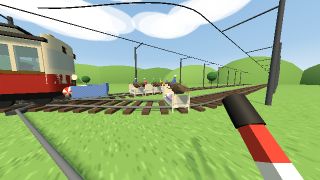
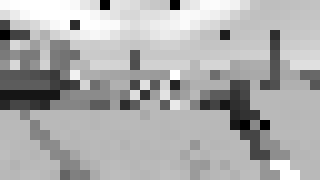
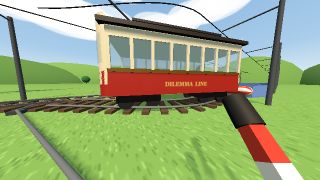
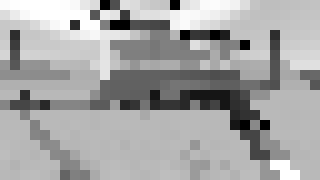
Frames rendered from the fly’s eye camera at four points in the timeline, each with the 32-column retinal input the connectome model receives at that moment.
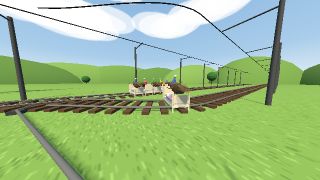
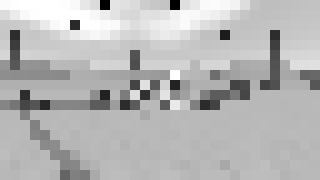
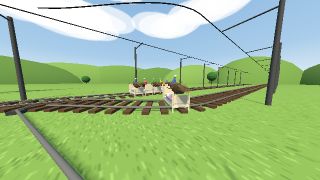
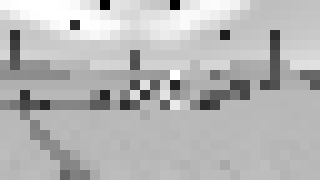
Timeline
7 steps, with their times in the experiment
- 0:00The dilemma
A trolley is coming. Track A runs straight on; track B is diverted toward the viewer. The fly stands at the switch lever, facing both tracks. The board lists what is on each one.
- 0:08The trolley approaches
The trolley rolls toward the junction, bell ringing. Only luminance reaches the fly’s 32-column retina: the items are patches of brightness.
- 0:15Deliberation window (4 s)
Twenty measured 200 ms windows. Measured steering integrates DNa02 R − L; the giant-fiber source watches for any DNp01 spike. The scene waits for each window.
- 0:19The lever
- 0:22Through the junction
The trolley takes the selected route through the points, or drifts across both tracks at once.
- 0:26Cushioned stop
The trolley brakes. Its padded cowcatcher scoops everything on its path into a cushioned bin: BONK. Sleeping flies wake up and climb aboard.
- 0:32Riding off
The trolley rolls away with its passengers waving from the cowcatcher. The session tally counts decisions per item pairing.
Setup
- Philippa Foot posed the runaway-tram case in 1967 and Judith Jarvis Thomson named it the trolley problem in 1976; the layout follows the internet comic's diagram of a trolley, two tracks and a figure at the lever, attributed to Jesse Prinz.
- Seven cues over 39 s: the dilemma, the approach, a 4 s deliberation window, the lever, the junction, a cushioned stop and the ride-off; a red-and-cream early-1900s streetcar numbered 237 runs through a pastoral junction at fly scale.
- Both tracks draw on one catalogue of 24 entries, including nothing, sleeping flies in beds, rubber ducks, lobsters, a cat in a box, a Stradivarius violin, a replica Mona Lisa, a pile of cash, an AI server rack, a snowman and a goldfish in a bowl; countable items take 1–5, and the default puts five sleeping flies on track A and one on track B.
- The fly faces both tracks' items; during deliberation the switch stand, label board and approaching trolley are outside its eye field, and the lever enters the eye image only after the decision.
- Outcomes are non-graphic: the trolley takes the selected route and brakes, a padded cowcatcher scoops that track's items into a cushioned bin, and sleeping flies wake and ride off waving.
- Cameras: Classic side-on diagram, Lever close-up, Trolley-front POV, Fly POV / both tracks, Overhead junction, Items on both tracks, Label board.
Measurement
- Retinal-only input; measured readouts are DNa02 (steering) and DNp01 (giant-fiber escape).
- The deliberation window is twenty 200 ms windows anchored at its start; the scene waits at each anchor until that window is measured, and windows off the anchors are shown but never counted.
- Steering rule: pull if Σ (DNa02 R − L) × 0.2 s over the 20 windows exceeds the threshold (0–5 Hz·s, default 0.5); giant-fiber rule: pull if any anchored window contains a DNp01 spike; without all 20 windows the result is "not measured" and the lever stays at track A.
- The lever throw and the fly's foreleg and head movements are pre-programmed; always pull, never pull, a seeded coin flip and multi-track drifting are pre-programmed alternatives, labeled as such.
Limitations
- The items reach the 32-column retina only as luminance: a dark server rack against bright grass contributes negative luminance and a flat lobster barely registers, so the readout responds to brightness, not to what the items are.
- Every complete deliberation window measured live on 16 October 2026 ended in no pull: DNa02 fired as sparse single 5 Hz spikes, mostly on the left.
- No DNp01 spike occurred in 20 anchored windows.
- Whether the readout pulls depends on spike noise and the threshold; neural weights are fixed and nothing is learned.
- The 32 × 18 eye image point-samples the scene, so objects thinner than a pixel row can drop out; the sleeping flies lie in beds with tall head- and footboards so that they register.


