macOS
Source code · guided setup
The Workstation
Research Associates get the complete source code: every experiment, the full connectome model and the instruments. Run it on Mac, Windows or Linux.
Get the source codeSetup guide
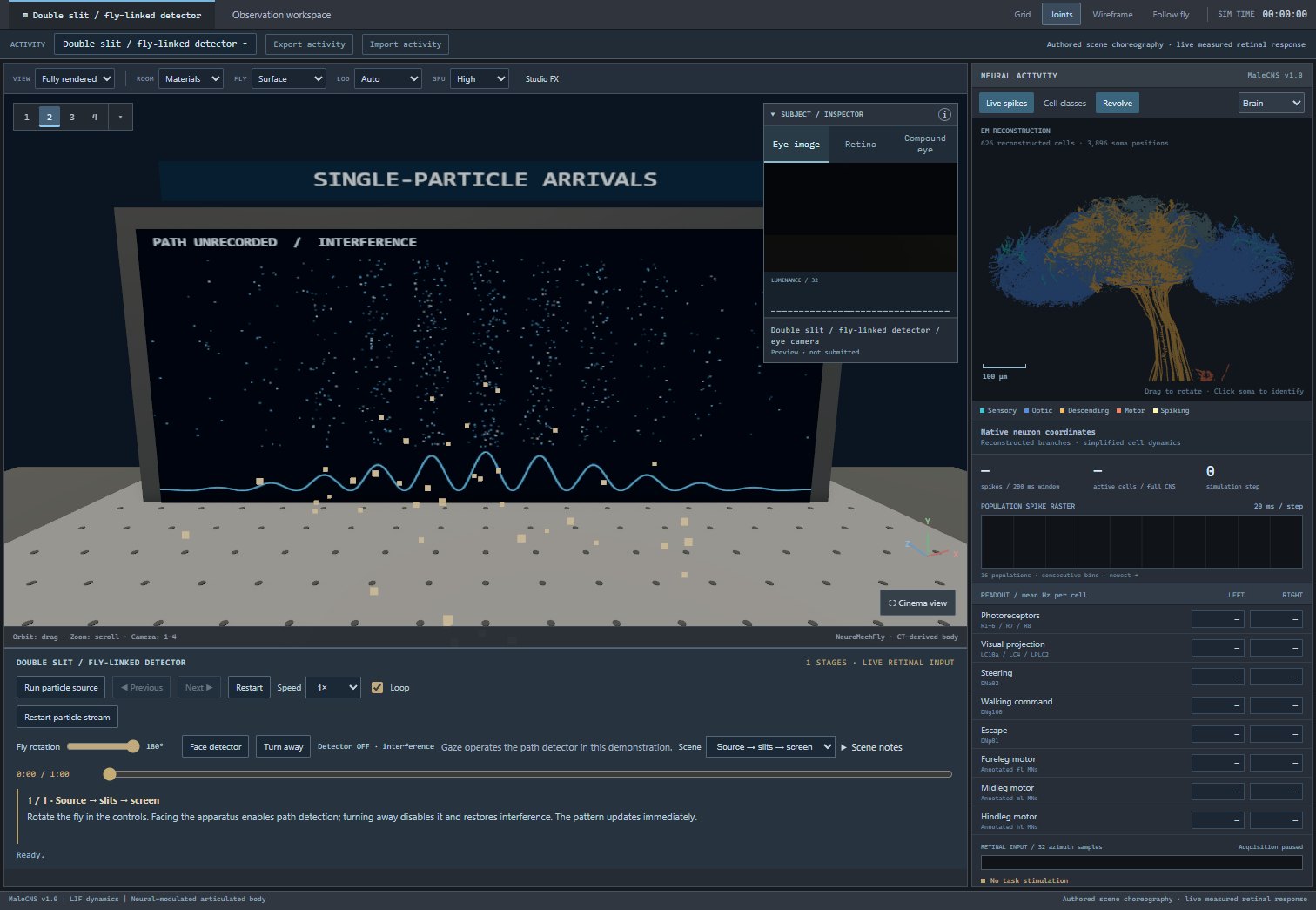
Download the source code, install three prerequisites and run setup. It downloads the connectome data and opens the workstation in your browser.
Source code · guided setup
Source code · guided setup
Source code · guided setup
Source code access is included with Research Associate on Patreon, $10+ a month. Become a Research Associate
All 68 experiments in the registry, each with its cameras, controls and timeline.
166,700 neurons stepping live, with spike rasters, population readouts and the reconstructed anatomy viewer.
Measured trials saved on your machine, and experiment packages you can export, share and import.
Experiment Builder’s Guide
The workstation comes with detailed, step-by-step instructions for building your own experiments: setting up a scene, placing the fly, writing the timeline, choosing cameras, recording the neural response, and packaging the result to share with other Research Associates.
Included as a guide on this site and as a PDF.
Hardware requirements are estimates. Setup guide
Research Associates get the workstation’s source code, new experiments as they are made, and a vote on what the fly does next.
Or do it yourself
Every dataset and package the workstation uses is listed here. Turning them into a working lab is a substantial engineering project.
FlyEM, HHMI Janelia. 166,700 neurons and 25,582,938 directed connections, as flat Feather tables.
SWC reconstructions from the MaleCNS segmentation, for the anatomy viewer.
The MaleCNS connectome as a spiking leaky integrate-and-fire network.
Micro-CT-derived body meshes and rigging, 69 segments. Wang-Chen et al., Nature Methods (2024).
1,709 micro-CT ommatidia directions from the Reiser lab, Nature (2025).
Stereo-derived Mars terrain and orthoimages.
Apollo 11 and 15 landing-site terrain and orthoimages.
Expect to need fluency in Python, TypeScript and WebGL, and working knowledge of spiking network models and connectome data. Or skip all of it: Research Associates get the finished source code for $10 a month. Become a Research Associate