
README
Retinal Bench
experimentNo. 0003categoryLabs & sensesrecordingpendingdataCC BY 4.0
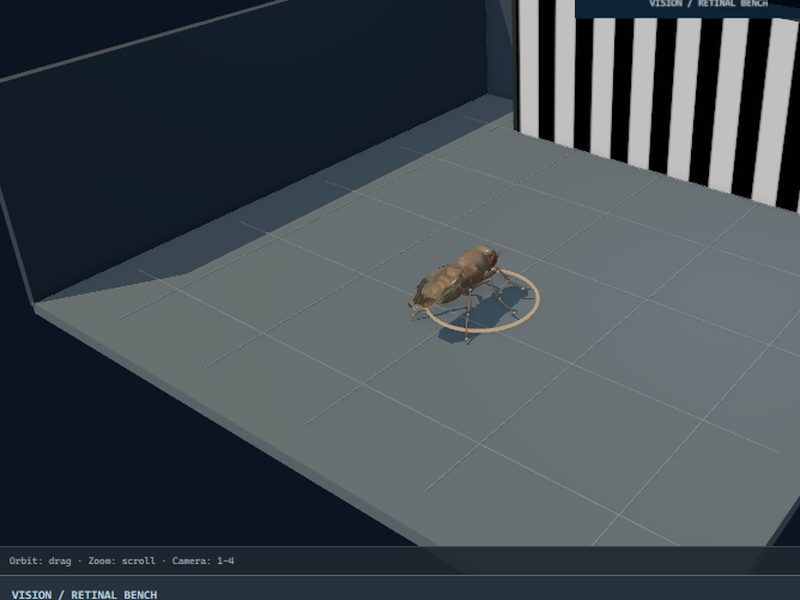
The fly faces a calibration display of bars, looming discs, gratings, half-fields or uniform white and black. The 32-column retinal input actually delivered is compared with direct drive of LC4/LPLC2 and LC10a.
Recording pending publication. Follow along for the release.
Setup
- A stimulus screen with seven patterns: bar, loom, grating, upper, lower, white, black.
- Channels: retinal input, looming feature cells (LC4, LPLC2) and moving-target cells (LC10a); side both, left or right; amplitude 0–1.2.
- Position fixed, guided tour, or manual arrow-key movement, all experimenter-controlled.
- Cameras: Arena, Fly, Plan, Stimulus.
Measurement
- Retina uses the canonical 32 × 18 render, RGB luminance averaged vertically, interpolated across the azimuth map, ×0.45, then the engine's eye gain.
- Measure paired response: 12 input samples; stimulus and disconnected branches share one noise seed; 10 baseline steps, 5 steps per sample and 10 recovery steps at 20 ms.
- Direct LC4/LPLC2 or LC10a stimulation bypasses retinal detection; directly driven cells are excluded from other readouts.
- 2026-09-21 calibration (seed 237): uniform retinal luminance raised retina by +12.48 Hz with steering and escape at 0 Hz; LC4/LPLC2 drive raised escape by +13.33 Hz.
Limitations
- Colour and vertical layout are discarded; this is not compound-eye optics.
- The graded early visual relay is absent from the spiking model.
- Calibration values hold for this short protocol and are not validations of vision.