
README
Odor Room
experimentNo. 0004categoryLabs & sensesrecordingpendingdataCC BY 4.0
The fly is placed or flown beside four labeled specimens: ripe fruit, microbial substrate, waste and decay. Supplied odor-proxy concentrations are compared with recorded receptor and relay responses.
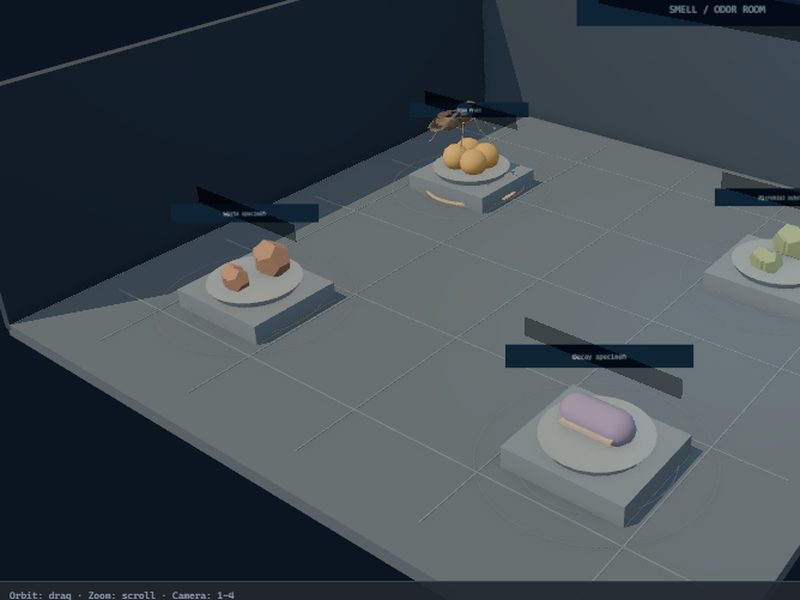
Recording pending publication. Follow along for the release.
Setup
- Four sources on dishes: ripe fruit (fruit ester + fermentation proxies), microbial substrate (geosmin proxy), waste specimen and decay specimen (model-specified amine mixtures).
- Channels: DM1 fruit ester, DM2 fermentation, DA2 geosmin and VM1 amine olfactory receptor neurons.
- Guided tour, manual arrow-key flight, or source buttons that place the fly beside a specimen; positions are experimenter-controlled.
- Meters show the local left/right supplied dose, separate from neural rates.
Measurement
- Local concentrations become normalized direct drives (0–1.2) to the annotated ORN classes per side.
- Recorded receptor rates and the corresponding projection-neuron relays (DM1, DM2, DA2, VM1) are measured against a paired disconnected branch with the same seed.
- Saturation and high disconnected odor activity are shown rather than subtracted.
- 2026-09-21 calibration: 0.6 left-side DM1 drive raised the DM1 relay by +15.00 Hz, with steering and escape at 0 Hz.
Limitations
- Mixtures and spatial fields are model-specified; waste and decay are not analytical chemical profiles.
- No terpene-specific detector is modeled; the amine channel is not a cadaverine-specific detector.
- The original sensory recurrence can saturate.