
Connectome Paddle Game
experimentNo. 0074categoryLabs & sensesrecordingpendingdataCC BY 4.0
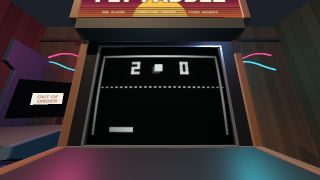
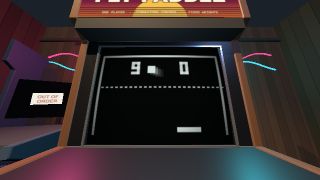
The fly plays a single-paddle arcade ball game on a rendered CRT, modeled on the DishBrain experiment in which cultured neurons played Pong. In closed loop, a measured right-minus-left firing rate (DNa02 by default) sets the paddle's velocity, scored against random and motionless paddles on the same serves.
An eight-second loop from the workstation. Full recording pending publication. Follow along for the release.
What the fly saw
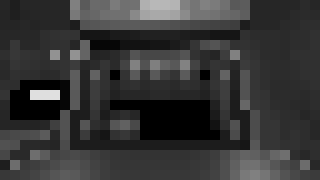
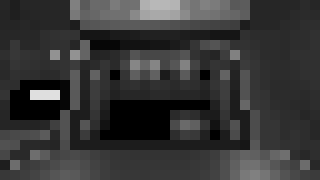
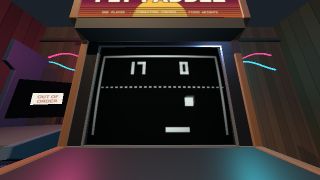
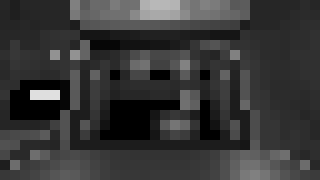
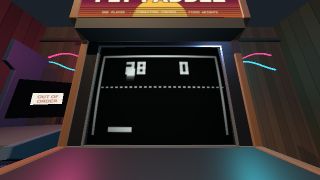
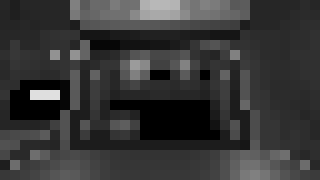
Frames rendered from the fly’s eye camera at four points in the timeline, each with the 32-column retinal input the connectome model receives at that moment.
Timeline
5 steps, with their times in the experiment
- 0:00Insert coin / attract mode
- 0:08Game 1 / slow serves
- 0:38Game 2 / faster serves
Ten faster serves. Hits and misses are scored only at the paddle line; the random and motionless paddles are scored on exactly the same balls.
- 1:08Game 3 / fast serves
Ten fast serves. The DishBrain-style feedback flashes after hits and fills the screen with static after misses. The weights stay fixed.
- 1:32Final score / measured vs baselines
The scoreboard compares the measured paddle with the random and motionless paddles on the same serves, with a 95% binomial interval. No learning: fixed weights.
Setup
- Five cues over 102 s: attract mode (8 s), three games of 8 slow, 10 faster and 10 fast serves, and a final score.
- The fly faces the screen of a procedural 1970s-style cabinet, with its head at the eye camera; the 4.4 × 3.3 tube fills about 80° × 64° of its eye image.
- The court is turned 90°: the paddle moves left and right along the bottom of the screen, the axis the 32-column retina resolves, and the far wall replaces the opponent.
- Feedback follows the DishBrain protocol: a regular full-screen flash after a hit and 0.8 s of random static in eight vertical bands after a miss; Silent (a blank pause) and Off are the controls.
- A fly-scale podium sits in front of the fly's chest, outside its eye image: pre-programmed foreleg motion drops a coin, presses START and rides the knob as it turns with the paddle, but never sets the paddle.
- Cameras: Arcade / fly at the controls, Screen / over the shoulder, Fly / antennae in the glow, Controls / coin, start and knob, Fly POV / the tube, Scoreboard / measured trace, Cabinet / side profile.
Measurement
- Retinal-only input: each 200 ms live window carries ten 20 ms frames of the screen, so the ball and paddle reach the model only as luminance; measured readouts are DNa02, HS + H2 and LC10a.
- Closed loop: paddle velocity = gain × filtered right-minus-left rate of the chosen readout, integrated once per measured window; the paddle moves only when a window ends, and the scene clock waits for measured coverage during the games.
- Open loop is a pre-programmed tracker that always meets the ball, and the random paddle is a seeded path that ignores it; neither is a measurement.
- Every paddle plays the same 28 seeded serves; in closed loop only crossings reached by contiguous measured coverage are scored, and the scoreboard gives hits, a 95% Wilson interval and a verdict against the random and motionless paddles.
Limitations
- Neural weights are fixed, so nothing can learn: the flash and static are a stimulus protocol only, and every score describes a fixed network's response to luminance.
- The paper's 100 Hz hit flash cannot be represented at a 20 ms model step, and its 4 s miss stimulus is condensed to 0.8 s.
- In live runs on 16 October 2026, DNa02 was mostly silent (31 of 208 windows non-zero, as single 5 Hz cells with a left bias), so the steering paddle drifted to the left wall: 1/9 hits, against 1/9 for the random paddle and 2/9 for the motionless one.
- HS + H2 gave a random walk across the court (1/5 hits) and LC10a 2/5; at these sample sizes none differs from the baselines.
- About three measured windows arrived per second of wall time, so the time-locked games ran at roughly half speed.


