
Stanford Prison Experiment Reconstruction (1971)
experimentNo. 0073categoryHistory & trainingrecordingpendingdataCC BY 4.0
The fly takes the place of a prisoner, a guard or an observer in a non-graphic, all-fly reconstruction of Philip Zimbardo's Stanford Prison Experiment (14–20 August 1971) in the Jordan Hall basement. The final stage presents the published critique: archival evidence (Le Texier 2019) and the BBC Prison Study, which did not reproduce the outcome.
An eight-second loop from the workstation. Full recording pending publication. Follow along for the release.
What the fly saw
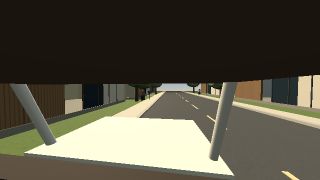
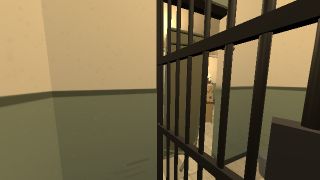
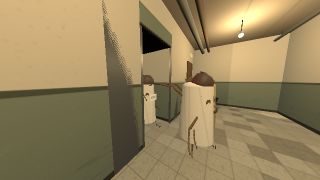
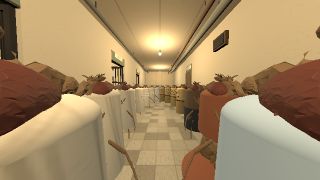
Frames rendered from the fly’s eye camera at four points in the timeline, each with the 32-column retinal input the connectome model receives at that moment.

Timeline
14 steps, with their times in the experiment
- 0:00Saturday: the guards’ orientation
Saturday 14 August 1971. The guards receive khaki uniforms, mirrored sunglasses, whistles and police batons. The blackboard repeats the list recorded at the archived orientation: boredom, frustration, fear, arbitrariness, loss of privacy, of freedom of action, of individuality — powerlessness.
- 0:18Sunday: mock arrests
Sunday 15 August. Palo Alto police “arrest” the volunteers at home on charges of armed robbery and burglary (Penal Codes 211 and 459). Prisoner 8612 is searched against the patrol car, handcuffed and driven away while neighbors watch.
- 0:34Booking at the Stanford County Jail
- 0:522:30 a.m.: the first count
Monday 16 August, 2:30 a.m. Whistles wake the prisoners for the first of many counts. They line up against the Yard wall and call off their ID numbers. Counts come several times a shift and grow longer through the week.
- 1:08Push-ups as punishment
Push-ups become a staple punishment for rule infractions or a poor attitude, already at the first count. A guard counts; the prisoners repeat until he is satisfied.
- 1:20Monday morning: the rebellion
The prisoners pull off their caps, tear off their numbers and push their cots against the barred doors. Reinforced guards drive them back with CO₂ fire extinguishers — present because the human-subjects review required them — remove the beds and put the ringleader, 5401, in the Hole.
- 1:38The privilege cell
Cell 1 becomes the privilege cell: its three least-involved prisoners get their beds back and eat a special meal in view of the others. About half a day later the guards swap prisoners between cells, breaking the prisoners’ solidarity.
- 1:52Monday night: 8612 leaves
Less than 36 hours in, prisoner 8612 is released after what staff described as acute emotional distress. In recordings from 1971 and 1972 and in a 2017 interview he said he acted it out to get out (Le Texier 2019; Blum 2018); Zimbardo (2018) disputes this.
- 2:06Tuesday: visiting hours
Tuesday 17 August. Staff take down the signs, have the prisoners washed and groomed, serve a large dinner and play music over the intercom. Visitors register, wait half an hour and get ten minutes with a prisoner under a guard’s eye.
- 2:22Tuesday night: the escape rumor
A guard overhears a rumor that 8612 will return with friends to free the prisoners. Staff dismantle much of the jail, take the prisoners, chained together, up to a fifth-floor storeroom, and the Superintendent waits alone in the empty corridor. No break-in comes.
- 2:38Wednesday: the chaplain
Wednesday 18 August. A Catholic priest who had been a prison chaplain interviews each prisoner in the Yard. About half introduce themselves by ID number. He tells them the way out of a prison is a lawyer.
- 2:52Thursday: the parole board
Thursday 19 August. The parole board, chaired by the staff’s consultant, a former prisoner, hears the prisoners one at a time. Asked whether they would forfeit the pay they had earned to be paroled, most say yes — then return to their cells when told to.
- 3:08Termination after six days
Thursday night Christina Maslach sees prisoners led to the night’s last toilet run, ankles chained and hands on each other’s shoulders, and objects. On Friday 20 August 1971 Zimbardo ends the study after six days of a planned two weeks.
- 3:26Critique: the archives and a replication
CRITIQUE — published evidence, presented neutrally. Archived tapes show the guards were told the aims, given a schedule and coached to be “tough” (Le Texier 2019); demand characteristics were raised in 1975. The BBC Prison Study (Reicher & Haslam 2006) did not reproduce the outcome.
Setup
- Fourteen seekable stages over 226 seconds follow the published accounts day by day, from the guards' orientation on Saturday 14 August 1971 and the Sunday mock arrests through booking, the 2:30 a.m. count, push-ups, the Monday rebellion, the privilege cell, prisoner 8612's release, visiting hours, the escape rumor, the chaplain and the parole board to the termination on Friday 20 August.
- A Subject role control places the fly as prisoner 5704 in Cell 2 (default), as a day-shift guard or as a research assistant at the observation opening; the fly replaces that figure, so the documented nine prisoners and three guards per shift are kept.
- The model has 24 fly figures, including the fly: nine prisoners identified only by published ID numbers, six guards, the Superintendent (Zimbardo), the Warden, the parole-board chair, a chaplain, Christina Maslach, a police officer, two visitors and a research assistant.
- The basement follows the documented layout: a 35-ft corridor section known as the Yard, three barred cells, the Hole, an observation screen with video equipment, offices in an adjacent wing, an intercom and CO₂ extinguishers.
- The final stage, labeled CRITIQUE, presents six notices as published, without adjudicating: the archived orientation tape, "tough guard" coaching, demand characteristics (Banuazizi & Movahedi 1975), prisoner 8612's later account, the BBC Prison Study (Reicher & Haslam 2006) and the termination.
- Nine cameras, including a first-person eye-camera view, the observation screen, a roof-off cutaway, the offices and the Palo Alto street; captions with called numbers, dates and short documented quotations are viewport-only.
Measurement
- Retinal-only input: the eye camera's 32 luminance columns reach the fixed connectome model, measured spikes drive the neural display, and no direct stimulation is sent.
- The role control moves only the fly and its eye camera; the model is not assigned a role, and nothing it does changes the pre-programmed timeline of arrests, counts, transfers, hearings and termination.
- The booking blindfold turns the retina nearly black and the guard's mirrored sunglasses, modeled at 40% transmission, dim every column; the fly's own costume and the captions are excluded from the retinal image.
- Browser tests check that the three roles give different retinal images at six stages and that each role’s retina is the same in all four render presets.
Limitations
- No strip search, delousing, nudity, bags over heads, humiliation or graphic abuse is shown; where a documented procedure is omitted, the stage text says so.
- Corridor width, ceiling height, cell assignments and room positions are estimates; cells are enlarged to fit three cots and three flies, and timing within each stage is condensed.
- The published accounts describe individual arrests at each volunteer's home; seating the fly in the rear of 8612's patrol car is not documented in the cited sources, and the car and street are generic rather than the 1971 Palo Alto livery or actual addresses.
- The sunglasses' 40% transmission is an approximation, not a measured lens; occupying prisoner 5704's place does not reconstruct that participant's behavior.


