
README
Boeing 767-200ER and Twin Towers Reconstruction
experimentNo. 0014categoryHistory & trainingrecordingpendingdataCC BY 4.0
The fly sits at the controls of a procedural Boeing 767-200ER flight deck in a metric reconstruction of the World Trade Center towers; the default pre-programmed approach ends on the North Tower's north face within floors 93–99.
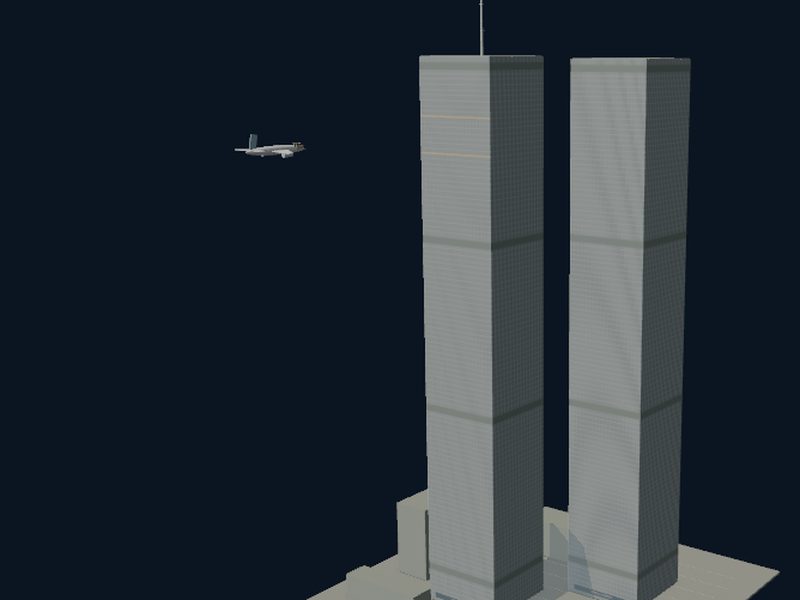
Recording pending publication. Follow along for the release.
Setup
- Towers and aircraft share a scale of 10 m per scene unit: roof heights of 416.9664 m and 415.1376 m, a 63.6524 m exterior width and a 110.3376 m North Tower antenna.
- The 767-200ER is 48.51 m long with a 47.57 m span.
- A procedural flight deck with paired seats and yokes, six instrument screens, analog dials, twin throttles and overhead switches; the fly's forelegs reach the captain's yoke grips.
- Twin Towers, North face / 93–99, Fly / controls, Cockpit / over shoulder and Plaza plan cameras.
- The four-second entry animation ends with a schematic facade mark; no collapse or structural response is simulated.
Measurement
- Retinal-only input; an external nearest-example readout of six downstream population rates selects a lateral endpoint within the floors 93–99 band.
- The aircraft uses simplified kinematics; instruments and control motion are non-functional visual elements, not flight dynamics or avionics.
Limitations
- The contact point uses simplified, equally spaced floors; it is not the surveyed impact coordinate.
- Tower placement and plaza massing are approximate; the playback is not a historical speed trace.
- Activity version 2; earlier version-1 packages describing different geometry are rejected.