
README
Torture Chamber: Six Documented Devices
experimentNo. 0045categoryHistory & trainingrecordingpendingdataCC BY 4.0
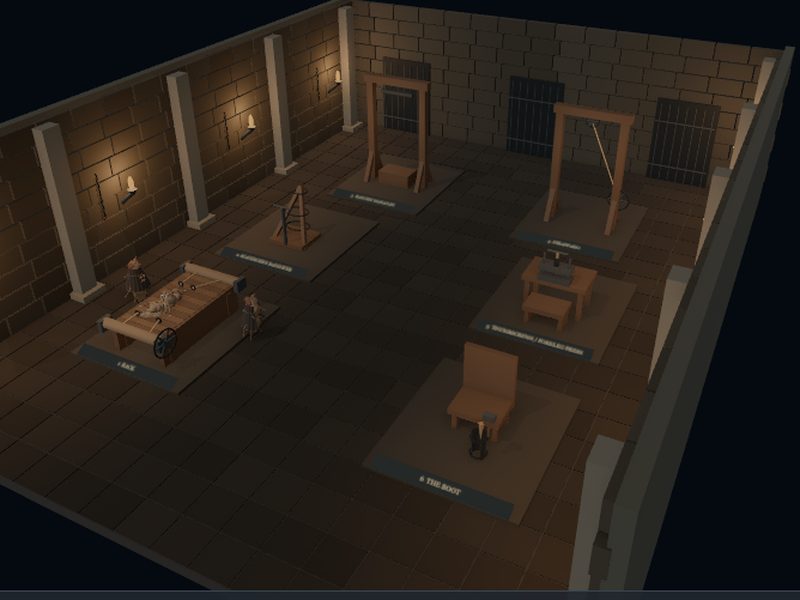
The fly tours a vaulted stone chamber and is placed at six documented early-modern devices in turn, while optional bounded direct stimulation and paired dose sweeps measure the fixed connectome model's response.
Recording pending publication. Follow along for the release.
Setup
- Six stations: the rack, the Scavenger's Daughter, hanging manacles, the strappado, thumbscrews configured as a foreleg press, and the boot fitted to one hind leg.
- A full circuit lasts 180 seconds; each 30-second station covers approach, mounting, restraint, demonstration, release and recovery.
- Barred cells, torch brackets, hanging chains and two robed attendants; station cameras, an interior aisle camera and a roof-off overview.
- Release / stop signal selects retina-only input, pauses the scene and releases the fly.
Measurement
- Default input is retina only. Optional direct contact/load drives the station's annotated tactile, chordotonal or campaniform populations; direct loom/escape drives LC4/LPLC2 and DNp01, at amplitude 0–1.2.
- The 4-dose sweep runs paired trials at 0, ¼, ½ and full amplitude (200 ms baseline, 800 ms stimulus, 200 ms recovery) with a fixed noise seed, restoring engine state after each pair.
- Directly driven cells are excluded from downstream aggregates; full records persist in SQLite.
- Fittings, mechanical movement and fly reactions are pre-programmed.
Limitations
- No injury physics is computed, and no pain, sentience, subjective experience or learning is inferred.
- The architecture is a generic vaulted-chamber model, not a reconstruction of one historical chamber.
- Rates saturate near 50 Hz at 20 ms steps; saturation and weak propagation are retained as measured.
- Red spike highlighting during the shaking phase is a programmed display color, not a pain measurement.