
README
Goat Laboratory Concentration Trial
experimentNo. 0043categoryHistory & trainingrecordingpendingdataCC BY 4.0
The fly holds both forelegs to its head in a period military test room while a goat shakes, heats, smokes and, at 30 seconds, ruptures into 128 fragments.
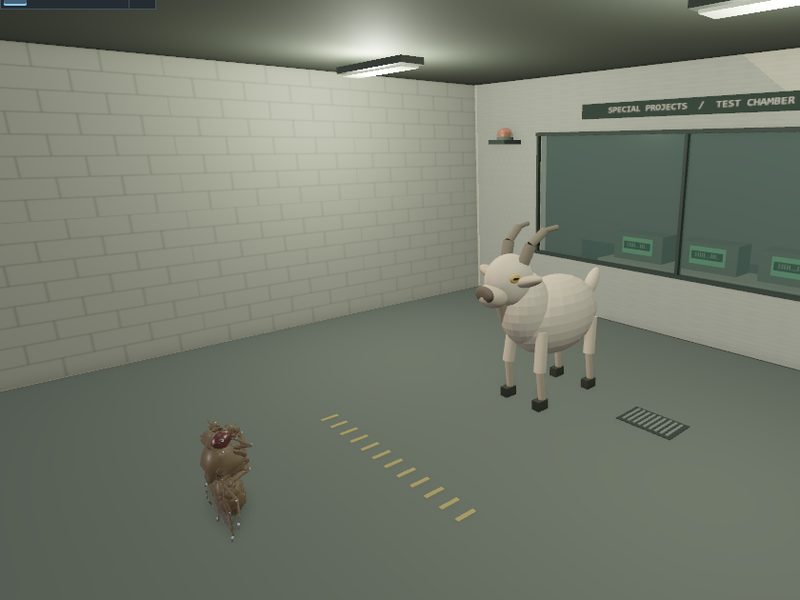
Recording pending publication. Follow along for the release.
Setup
- Seven stages over 53 seconds: facing the goat, concentration, shaking, heat and smoke, rupture, window and wall impacts, and the settled room.
- Fragments strike four walls, the observation window and the floor; wall fragments slide down while red streaks lengthen behind them.
- Two amber rotating beacons sweep the room during shaking and heating; a faint, viewport-only holographic spiral surrounds the goat until rupture.
- Five cameras: the test chamber, the fly's foreleg pose, the goat, observation-window impacts and the view from behind the observation glass.
- Loop is off by default; a replay control starts at the heating stage.
Measurement
- Retinal-only live input reaches the fixed connectome model; neural weights are not changed.
- The concentration pose and the explosion are pre-programmed; the goat's sequence follows a fixed programmed timeline.
- The holographic spiral is excluded from the retinal image.
Limitations
- The cited accounts describe an alleged attempt to stop a goat's heart by staring, not an exploding goat; heating, rupture and gore are included in the model without a documented source.
- The room is an original period-style model, not a survey of a historical facility; no historical experiment result is fabricated.
- Fragment flight uses deterministic trajectories and gravity; the subsequent slides are pre-programmed, not a tissue model.