
README
Project Pigeon Nose-Cone Guidance
experimentNo. 0064categoryHistory & trainingrecordingpendingdataCC BY 4.0
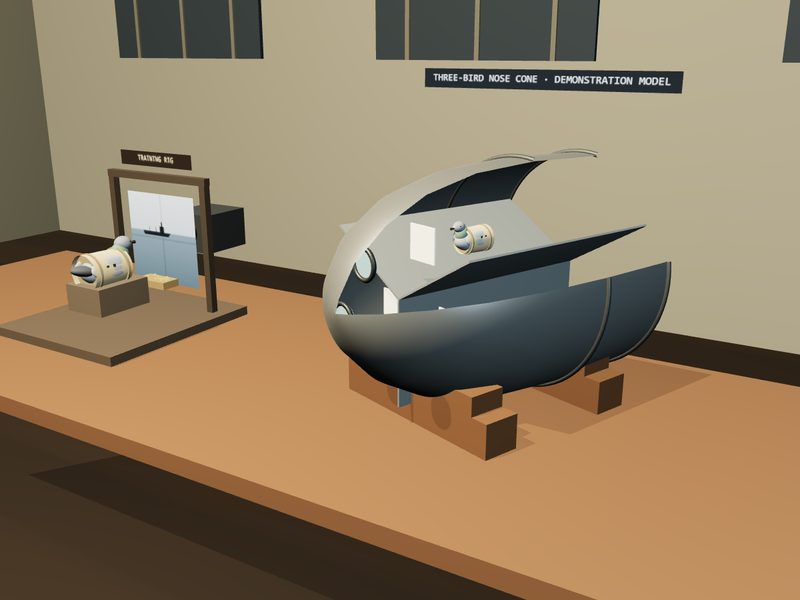
In a counterfactual substitution, the fly takes the pigeon's place in the nose cone of a guided glide vehicle; in closed-loop mode its measured DNa02 right-minus-left firing rate turns the vehicle toward a projected target ship.
Recording pending publication. Follow along for the release.
Setup
- Nine seekable stages over 112 seconds: Skinner's training rig, the three-bird nose cone, Project ORCON, boarding, release, guided glide, terminal approach, splash marker and trajectory report.
- Condensed approach geometry: 4,000 m release range and 900 m release height; the test vehicle is inert and the outcome is a splash marker.
- Controls: closed or open loop, gain (0–6 °/s/Hz, default 1.5), filter τ (0–2 s, default 0.4 s) and release aim error (±20°, default 8°).
- Seven cameras, including the projection screen over the fly's shoulder, a glide-vehicle chase, the incoming target ship and a range map.
Measurement
- Retinal-only input; DNa02, LC10a and HS + H2 rates are reported as fixed measured readout groups.
- Closed loop: during guided glide and terminal approach only, each measured 200 ms window turns the vehicle by gain × filtered (DNa02 R − L), which changes the next retinal image.
- Open loop: a pre-programmed correction path is flown and measured output is only displayed. Elevation, speed and timing are pre-programmed in both modes.
Limitations
- The fly substitution has no historical counterpart; the historical programs, Project Pigeon (1940–44) and the Navy's Project ORCON (1948–53), used trained pigeons.
- The steering coupling is an engineered mapping applied to a fixed-weight model; no learning occurs.
- Single-cell rates in a 200 ms window move in 5 Hz steps.