
README
Motor Circuits Bench
experimentNo. 0011categoryLabs & sensesrecordingpendingdataCC BY 4.0
Identified command populations in the fly's connectome (steering, escape, forward and backward walking, halting, freezing, grooming and proboscis output) are stimulated directly and downstream propagation is measured.
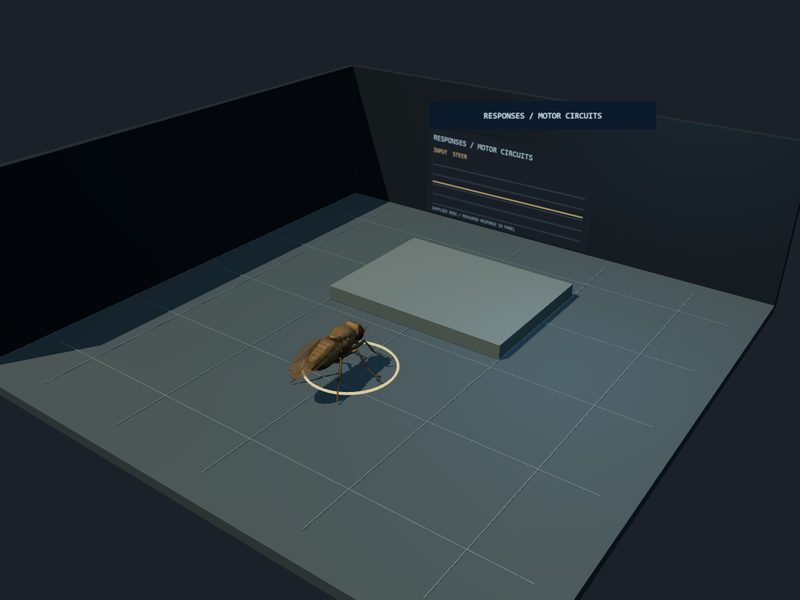
Recording pending publication. Follow along for the release.
Setup
- Nine channels: DNa02 steering, DNp01 escape, DNg100 forward walking, MDN backward walking, BRK halting, DNp09 running/freezing, aDN1 + aDN2 anterior grooming, DNp29 abdominal grooming, MN9 proboscis output.
- Side both, left or right; amplitude 0–1.2; cameras Arena, Fly, Plan, Stimulus.
- Replay measured response plays both recorded branches in the shared anatomy viewer.
Measurement
- Direct positive normalized current to the named command cells; directly driven cells are excluded from downstream readouts.
- Paired stimulus and disconnected branches with the same seed; mean Hz per neuron reported for stimulus, disconnected and their difference.
- Body playback is a pre-programmed animation illustrating a measured readout, not a mechanical simulation of the motor circuit.
Limitations
- Command injection does not establish a spontaneous behavioral choice.
- DNp09 is state-dependent in living flies; there is no one-cell freezing switch.
- DNg100 is a named walking candidate; its body playback uses an engineered decoder.