
Moloch's Bronze Idol at the Carthage Tophet (Diodorus 20.14)
experimentNo. 0089categoryHistory & trainingrecordingpendingdataCC BY 4.0
The fly is led at night through the tophet of Carthage, laid in the palms of a bull-headed bronze idol and dropped into its fire, following hostile Greek, Roman and rabbinic accounts of Carthaginian child sacrifice. A control switches between Diodorus Siculus's sloping palms over a pit of fire and the chain-lifted arms of Flaubert's novel Salammbô (1862) and the film Cabiria (1914).
An eight-second loop from the workstation. Full recording pending publication. Follow along for the release.
What the fly saw
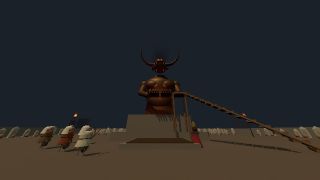
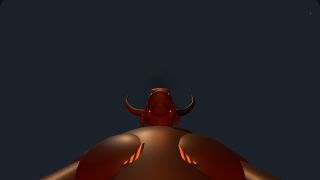
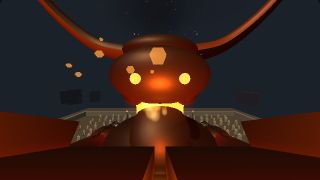
Frames rendered from the fly’s eye camera at four points in the timeline, each with the 32-column retinal input the connectome model receives at that moment.





Timeline
12 steps, with their times in the experiment
- 0:00Night at the tophet
Rows of small stone stelae and urns fill the precinct. The bronze idol sits on its pedestal, bull-headed, arms held out. The subject waits among the crowd.
- 0:10Stoking the idol
Stokers feed logs through the door in the back of the pedestal. The seven grates in the idol’s chest and its eyes begin to glow.
- 0:22Drums and flutes
Three drummers and two flute players start up beside the idol. The crowd sways; smoke curls from the bronze nostrils.
- 0:34Up the scaffold
Two priests lead the subject across the precinct and up the wooden stair to the platform beside the idol’s hands.
- 0:48Into the palms
The subject lies back across the two bronze palms. The priests step away.
- 0:58The windlass turns
Classic: four priests push the capstan behind the idol, the chains tighten over the shoulders and the arms begin to rise. Diodorus: the palms do not move; they slope down, and the subject starts to slide.
- 1:12Toward the fire
Classic: the arms swing up and the glowing mouth fills the subject’s view. Diodorus: the subject slides to the fingertips above the glowing pit.
- 1:26The offering
Classic: the palms tip at the mouth and the subject drops inside. Diodorus: it rolls off the palms into the pit of fire.
- 1:32Flare
A fireball bursts out with a spray of cooked fly. Embers spiral up past the horns and the drums beat at full volume.
- 1:42Inside the fire
The subject’s eye sees only flame and glowing bronze.
- 1:52The drums stop
The music stops and the arms are lowered. Smoke pours from the nostrils; the crowd stands still.
- 2:02An urn under a stele
A priest carries a small urn into the rows and sets it at the foot of a new stele, as the urns of burnt bone were found in the tophet.
Setup
- 12 seekable stages over 134 seconds: night at the tophet; stoking the idol; drums and flutes; up the scaffold; into the palms; the windlass turns; toward the fire; the offering; flare; inside the fire; the drums stop; and an urn set under a new stele.
- The precinct holds rows of instanced stelae with urns, torches on poles and the distant city. The idol sits on a stepped pedestal with a stoking door at the back; it has seven grated hatches in its chest, eyes that glow and a hinged jaw.
- Cast: three drummers, two flute players, two stokers, two escort priests, four priests at the capstan and a high priest, with 54 instanced spectators.
- Idol control: Classic (default), where four priests turn a capstan, chains raise the arms and the palms tip the subject into the glowing mouth and down to the chest furnace; or Diodorus 20.14.6, where the palms stay fixed and slope down and the subject rolls into a pit of fire in front of the pedestal. Warming input (VP2) is off by default. Gore (Low / Standard / Extreme, default Extreme) and blood tone (cinematic red or fly hemolymph) are scene controls, and the eye camera sees the splatter.
- 8 cameras, including the tophet overview, the idol from below, palms and mouth, the pit of fire, the drums and flutes, the new stele, a first-person fly view and a cutaway of the furnace and chains, which hides the right half of the torso and head in the viewport only.
Measurement
- Assay backend: the eye camera's 32 luminance columns reach the fixed connectome model and measured spikes drive the neural display. The only optional extra is a bounded drive to the VP2 warming thermosensors (amplitude 0–1.2). It is off by default, it is a relative drive rather than a temperature, and every response reports it.
- When the drive is on, it follows the idol's programmed heat, scaled by where the subject is: in the crowd, on the palms, approaching the mouth or pit, or inside the fire.
- The eye image shows the head and glowing mouth approaching (Classic) or the palms sloping to the pit (Diodorus), then only flame and glowing bronze. Bloom sprites on the grates are excluded from it, and the cutaway changes only the viewport.
- The idol, the fire, the music and every figure follow a pre-programmed timeline; measured spikes do not move the fly.
Limitations
- The ancient sources are Greek, Roman and later rabbinic writers hostile to Carthage; Diodorus and Plutarch wrote centuries after the events. The bull head and drums follow the rabbinic tradition (Rashi on Jeremiah 7:31). The calf's face and seven chambers appear in later midrash (Yalkut Shimoni) and have not been verified.
- The Classic mode's moving arms and furnace mouth are not documented in the ancient sources; they come from Salammbô and Cabiria and are labelled “classic” for that reason.
- The tophet urns of burnt infant and animal bone are real, but whether they record sacrifice or a cemetery for children who died young is debated (Xella et al., Antiquity, 2013; Schwartz et al., PLoS ONE, 2010 and 2012). The closing urn placement does not settle the question.
- The idol's size, anatomy, grates, capstan, chains, stair and pit are approximations. The fireball and splatter are cartoon gore for an all-fly cast, and no child figure appears.


