
Templo Mayor Heart Sacrifice, Tenochtitlan 1487
experimentNo. 0093categoryHistory & trainingrecordingpendingdataCC BY 4.0
The fly climbs Huitzilopochtli's stair on the Templo Mayor of Tenochtitlan at the head of a line of captives, is stretched face down over the techcatl stone, and has its heart (a fly's dorsal vessel) drawn out and raised to the sun. The scene follows Diego Durán's account of the 1487 rededication under Ahuitzotl and the heart sacrifice described in Sahagún's Florentine Codex.
An eight-second loop from the workstation. Full recording pending publication. Follow along for the release.
What the fly saw
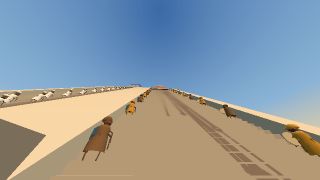
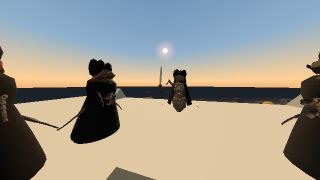
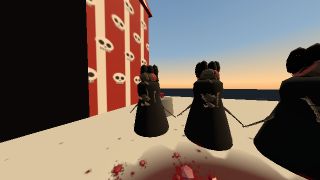
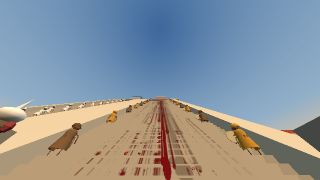
Frames rendered from the fly’s eye camera at four points in the timeline, each with the 32-column retinal input the connectome model receives at that moment.

Timeline
12 steps, with their times in the experiment
- 0:00Dawn over Tenochtitlan
The twin shrines stand on top of the Templo Mayor: Huitzilopochtli’s painted red and white, Tlaloc’s blue and white. The plaza below is packed.
- 0:12Lines of captives
Captives in white down and paper stand in long lines across the plaza and up the south stair. The fly is in the line.
- 0:24The climb
The fly climbs the steep steps of Huitzilopochtli’s stair between ranks of eagle and jaguar warriors.
- 0:38The summit
At the top: conch trumpets and the great drum, the two shrines, and the techcatl, the pointed sacrificial stone, in front of Huitzilopochtli’s door.
- 0:48Six priests
Six priests painted black, their hair long and matted, seize the fly by its six legs and stretch it face down over the stone so that its back arches up.
- 0:58The flint knife
The officiant raises a broad flint knife and brings it down along the back of the abdomen. The cuticle splits.
- 1:06The heart to the sun
A fly’s heart is the dorsal vessel, a tube along the top of the abdomen. The priest draws it out, still pulsing, and raises it to the sun.
- 1:18Into the eagle vessel
The heart is laid in the stone eagle vessel. Blood runs from the stone and down the stairs.
- 1:26Down the stairs
The priests roll the body off the platform. It tumbles down the long stair, bouncing and spraying from step to step.
- 1:40The Coyolxauhqui stone
It comes to rest on the great carved disk at the foot of the stair, which shows the moon goddess Coyolxauhqui dismembered.
- 1:48The skull rack
Beside the stair stands the tzompantli: rows of poles strung with heads. Here they are fly heads, thousands of compound eyes in rows.
- 2:00The next captive
The next captive starts up the stair. Durán wrote of 80,400 victims over four days; modern historians dispute that figure.
Setup
- 12 seekable stages over 130 seconds: dawn over Tenochtitlan; lines of captives; the climb; the summit; six priests; the flint knife; the heart to the sun; into the eagle vessel; down the stairs; the Coyolxauhqui stone; the skull rack; and the next captive.
- Metric scale (the standing fly is about 1.3 m). The twin temple faces west over a packed plaza in four sloping tiers, 28 m to the platform, and its stairs rise 28 m over a 24 m run. Huitzilopochtli's shrine is red and white with rows of skulls and Tlaloc's is blue and white; in front stand the skull rack of fly heads on poles and two towers of heads, and the volcanoes rise beyond the lake.
- Cast: an articulated officiating priest in a black cloak and six priests with long matted hair who hold one leg each. Crowd (80–700, default 420) sets the instanced spectators, eagle and jaguar warriors and captives in white down, including a second line of captives on Tlaloc's stair.
- Sun: a low afternoon sun behind the priest (default) or a high sun, changing the lighting only. Gore (Low / Standard / Extreme, default Extreme) and blood tone (cinematic red or fly hemolymph) are scene controls; the eye camera sees the splatter, including the blood running from the stone and down the stair.
- 8 cameras: a director view, the plaza and twin temple, the heart raised to the sun, the techcatl close up, up the stair, the skull rack, the Coyolxauhqui stone, and the fly's eye. A replay control jumps to the heart stage.
Measurement
- Retinal-only input: the eye camera's 32 luminance columns reach the fixed connectome model, measured spikes drive the neural display, and no direct stimulation is sent.
- The eye looks up the stair at the shrines and at the officiant with his knife on the stone, including its own heart being drawn out. During the fall it looks down the stair, and from the disk it looks back up at the temple. The opened back is excluded from the eye image as part of the fly's own body.
- The climb, the priests and the fall follow a pre-programmed timeline, and measured spikes do not move the fly. The shared gait phase is pinned to scene time, so seeking during the climb is exact.
Limitations
- Documented in the sources: twin shrines to Huitzilopochtli and Tlaloc, the techcatl before Huitzilopochtli's shrine, priests holding the limbs while the officiant opens the body with a flint knife, the heart raised and placed in an eagle vessel, bodies thrown down the stair, the Coyolxauhqui stone at the foot of the stair, and skull racks of heads on horizontal poles with skull towers.
- Durán's 80,400 victims over four days is one chronicle's figure, and modern historians dispute it; modern estimates are far lower. The scene does not show a count.
- Approximations: six holders, one per fly leg, instead of four for the limbs and one for the head; the face-down position, because a fly's heart is dorsal; the pyramid's proportions, tiers and painted decoration; the skull patterns; the plaza and city; the sun position; and all timing.
- The Coyolxauhqui monolith found in 1978 belongs to an earlier building stage (IVb, c. 1469) and would have been covered by 1487. Its relief is redrawn as a dismembered fly.


