
Guillotine, Place de la Révolution 1793: Neck-Cut Connectome Model
experimentNo. 0096categoryHistory & trainingrecordingpendingrunsin browserdataCC BY 4.0
The fly is guillotined on the Place de la Révolution in 1793, and after the blade the eye camera rides the severed head. By default, each live window from the cut onward runs on a labelled neck-cut model that zeroes every synapse between head-side and body-side neurons and then restores them.
An eight-second loop from the workstation. Full recording pending publication. Follow along for the release. Meanwhile, run it in your browser.
What the fly saw
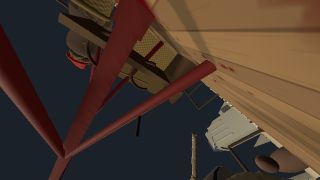
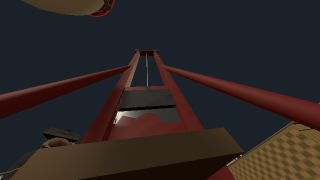
Frames rendered from the fly’s eye camera at four points in the timeline, each with the 32-column retinal input the connectome model receives at that moment.
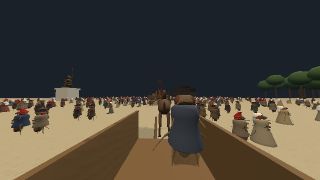
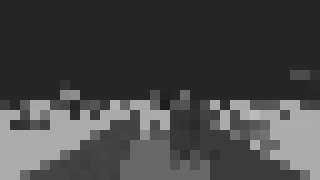
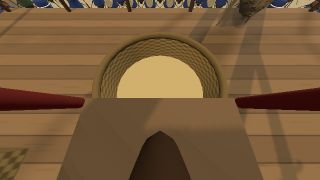
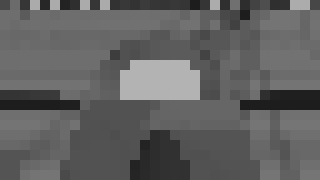
Interactive preview. Run this experiment in your browser with its cameras, the compound-eye inspector, wireframe views and a simulated neural panel. Run in browser
Timeline
13 steps, with their times in the experiment
- 0:00Place de la Révolution, 1793
Morning in the great square. The plaster statue of Liberty stands on the empty pedestal of Louis XV; the scaffold rises near the Tuileries gate. National Guards ring it with bayonets.
- 0:08The tumbrel
A horse-drawn tumbrel brings the condemned fly across the square from the rue Royale, its forelegs bound behind it. The crowd presses in and jeers.
- 0:22Up the scaffold
The executioner’s assistants help the fly down from the cart and up the wooden steps to the platform.
- 0:30The bascule
The fly is pushed against the upright plank. Two leather straps are buckled across its thorax and abdomen.
- 0:37Tipped and slid
The plank tips forward to horizontal and slides on its runners until the neck rests in the lower half of the lunette.
- 0:40The lunette closes
The upper half of the wooden collar drops and locks. Below, the wicker basket waits, already stained.
- 0:45Drum roll
The drums roll and the crowd falls quiet. Charles-Henri Sanson takes the release lever.
- 0:48The blade
The oblique blade and its iron weight drop down the grooved uprights. The head falls into the basket.
- 0:52The head rolls
The head clips the basket rim, bounces out and rolls across the boards. The eye camera rides it, the square tumbling past.
- 1:00The headless body
The body kicks on the plank while the neck pulses red across the scaffold. An assistant prods it with a stick; the legs answer.
- 1:12Shown to the people
The assistant picks the head up by an antenna and holds it high, turning it to each side of the square. The crowd roars.
- 1:24Into the baskets
The head is tossed into the basket. The straps are undone and the body is tipped sideways into the long wicker panier.
- 1:34The next tumbrel
The bloody blade is hauled back up its rope. The crowd thins as the next tumbrel turns in from the rue Royale.
Setup
- 13 seekable stages over 106 seconds: Place de la Révolution, 1793; the tumbrel; up the scaffold; the bascule; tipped and slid; the lunette closes; drum roll; the blade; the head rolls; the headless body; shown to the people; into the baskets; and the next tumbrel.
- Metric scale (the fly is about 1.6 m upright). The square has the plaster Liberty on the empty pedestal of Louis XV's statue, Gabriel's twin palaces to the north, the Tuileries gate with its winged horses to the east, and the scaffold ringed by National Guards. The machine's uprights, oblique blade and mouton, bascule, two-part lunette, basket and panier follow the 1792 design and period engravings.
- Charles-Henri Sanson, two assistants and a tumbrel driver are articulated cast flies. 520 instanced townsfolk include sans-culottes, women in gowns and mob caps, the guard ring, a line of six drummers and eight seated knitters.
- Released at 48 s, the blade falls freely and crosses the neck at about 48.8 s. The falling head is a 0.17 m rigid sphere integrated at 240 Hz against the boards, the 26 cm bran basket's bottom, wall and rim, and the railing. Each Head bounce seed (1–9, default 4) is a fixed, replayable trajectory: seeds 2–5 bounce out, and 1 and 6–9 stay in.
- Controls: Neck-cut model after the blade (on by default), Touch the headless body (off by default), Body twitch (pre-programmed by default, or scaled by the measured leg-motor rate) and Head bounce. Gore (Low / Standard / Extreme, default Extreme) and blood tone (cinematic red or fly hemolymph) are scene controls, and the eye camera sees the splatter.
- 8 cameras: the square from the crowd, the side of the machine, the blade and lunette close up, the severed head's point of view (rolling with it), following the head, the headless body on the plank, the tumbrel route, and the crowd's view of the head being shown.
Measurement
- Retina throughout: the eye camera's 32 luminance columns reach the fixed connectome model and measured spikes drive the neural display. After the cut the eye camera rides the severed head through every bounce and roll.
- With the neck-cut model on, each live window from the cut onward zeroes 817,529 of 25,582,938 synapses and then restores them on the neural owning thread; the model file is never modified. The cut removes every synapse between head-side neurons (optic lobe, central brain, visual projection, and descending neurons, whose dendrites are in the brain) and body-side neurons (ventral nerve cord and ascending neurons). The 50 enteric or unassigned cells are never cut.
- Touch the headless body sends a bounded drive (touch 0.9, notum 0.6) during the five visible prods, to body-side tactile (2,130 cells) and thoracic (214 cells) afferents only. Readouts are LC4 + LPLC2, DNp01, all descending neurons and all leg motor neurons. The execution follows a pre-programmed timeline and measured spikes do not move the fly. The one exception is the measured Body twitch option, which scales the headless body's kicking by the latest measured leg-motor rate (held between windows, reset on seek).
- First live measurement (2026-10-17, uniform grey input, 15 windows each, means). Intact: leg motor 2.69 Hz, descending 2.51 Hz. Neck cut: 2.15 Hz and 3.58 Hz. Intact again: 2.68 and 2.48 Hz, confirming the weights were restored. Cut plus body touch raised leg motor to 2.92 Hz, and intact plus touch to 3.33 Hz.
Limitations
- The neck cut is a compartment approximation, not an anatomical transection: the graph has one point per neuron and no synapse locations. There are no injury currents, no hemolymph loss and no time course of decapitation, and the weights are otherwise fixed.
- The first measurement consists of small single runs on a fixed-weight model, not a characterised decapitation result.
- The square's layout, the building proportions, the crowd size and the timing of the toilette, the climb and the drop are approximations. Executions moved between sites; the Place de la Révolution (now Place de la Concorde) was the main site in 1793.
- Showing the head to the people is documented practice. Stories of heads blinking or blushing afterwards are legends and are not shown as fact.


