
Apartment 213, Milwaukee, July 1991: Crime Scene Reconstruction
experimentNo. 0108categoryHistory & trainingrecordingpendingdataCC BY 4.0
The fly is the occupant of Apartment 213 at 924 N. 25th Street, Milwaukee, in an all-fly reconstruction of the night of 22 July 1991 and the removal of evidence the next afternoon, built from the criminal complaint and police and press accounts.
An eight-second loop from the workstation. Full recording pending publication. Follow along for the release.
What the fly saw
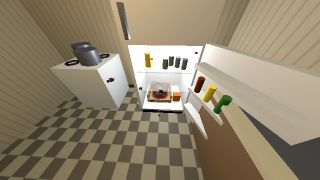
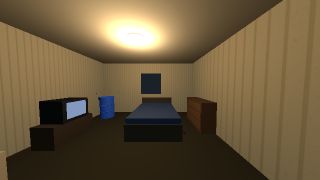
Frames rendered from the fly’s eye camera at four points in the timeline, each with the 32-column retinal input the connectome model receives at that moment.
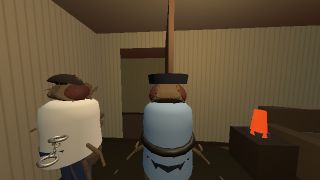
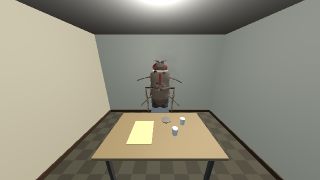
Timeline
13 steps, with their times in the experiment
- 0:00North 25th Street, 22 July 1991
A warm Monday night. Most windows of the three-storey block are dark. In Apartment 213 on the second floor the lava lamp and the fish tank glow.
- 0:10At home
The collector, in large tinted aviator glasses and a grey zip-collar top, gets up from the sofa. The flat stinks; house flies circle the kitchen doorway.
- 0:22The refrigerator
He opens the refrigerator. On the bottom, in an open cardboard box beside a box of baking soda, sits a severed head. Beer and mustard on the shelves above.
- 0:36The freezer
He lifts the lid of the floor freezer against the west wall. Cold mist rolls out over three more heads, frozen into the frost.
- 0:48The shrine he planned
He sits in the black leather chair facing the black table and pictures the plan: skulls in a row, a full skeleton at each end, incense at both ends, blue globe lights above.
- 1:06The blue drum
In the bedroom corner he lifts the lid of the 57-gallon blue drum. Fumes rise off a dark soup in which three torsos turn over.
- 1:1811:30 pm: the escape
A guest breaks away with a handcuff locked on one wrist. He runs down the stairs, out onto the street, and waves down a passing squad car.
- 1:32Back to 213
He asks the two officers to get the cuff off and says the man meant to kill him. They walk him back upstairs. The collector opens the door and lets them in.
- 1:44The drawer
Looking for the handcuff key, one officer opens the top dresser drawer. It is full of Polaroids of bodies being taken apart. “These are for real.”
- 1:56The head in the refrigerator
The collector fights; he is pinned to the floor and cuffed behind his back. The officer opens the refrigerator and finds the head looking back at him.
- 2:08Squad cars
Squad cars fill the street, red and blue on the brick. The collector is walked down the stairs in cuffs. “You think you’ve seen it all out here, and then something like this happens.”
- 2:18The removal, 23 July
Next afternoon a team in bright yellow rubber suits and air masks carries the refrigerator, bound with duct tape, down to a truck, then the drum.
- 2:36Four rows deep
Neighbours crowd the police tape four rows deep. Across town, in an interview room, the collector talks to a detective through hours of cigarettes.
Setup
- Thirteen seekable stages over 168 seconds: North 25th Street at night, the occupant at home, the refrigerator, the floor freezer, the shrine he later described planning, the 57-gallon blue drum, the 11:30 pm escape of a handcuffed guest, the officers’ return to Apartment 213, the Polaroids in the top dresser drawer, the arrest and the refrigerator opened, the squad cars, the hazmat removal on 23 July, and the crowd at the police tape with the interview room.
- Items sit where the record places them: the refrigerator on the south wall with a head in an open box beside a box of baking soda, three heads in the floor freezer on the west wall, three torsos in the drum, painted skulls in the filing-cabinet drawer and more in a computer box and on a closet shelf, and the black table, the aquarium and the lava lamp.
- The planned shrine (seven skulls in a row, a complete skeleton at each end, incense at both ends and blue globe lights) appears piece by piece as he later described it to detectives, then disappears; it was never built.
- Every person is a fly identified by role and clothing: the occupant in large tinted aviator glasses and a grey zip-collar top, the escaped guest with a handcuff on one wrist, two officers, five hazmat workers in yellow suits and air masks, a detective, two more officers by three squad cars, and 64 instanced neighbours behind the tape.
- Gore (Low / Standard / Extreme, default Extreme) and blood tone (cinematic red or fly hemolymph) are scene controls; the eye camera sees the splatter. House flies (0–80, default 40) circle the remains, Shrine globes are blue (default) or off, Evidence tags are on by default and display only, and a replay control returns to the refrigerator.
- Eight cameras: Director (auto), North 25th Street, the kitchen, inside the refrigerator, the black table, the bedroom, a cutaway of the whole flat from above with the roof lifted in the viewport, and the collector’s eyes.
Measurement
- Retinal-only input: the eye camera’s 32 luminance columns reach the fixed connectome model, measured spikes drive the neural display, and no direct stimulation is sent.
- The refrigerator light, the blue shrine light and the squad cars’ light bars are scene lights, so they reach the eye image; the evidence tags and the occupant’s own glasses, hair and clothes are excluded from it. In the last stage the eye sees the interview room.
- The fly’s movements and the cast follow a pre-programmed timeline; measured spikes do not move the fly.
Limitations
- No floor plan was ever published and only the wall positions of the main items are recorded, so the room layout, the officers’ route up the stairs, the squad cars and their light bars, the truck, the interview room and all timing are approximations.
- Accounts differ on how many heads were in the refrigerator (one in the complaint, three in early reports), how many skulls were painted, whether the drum held acid (the medical examiner reported none, so the fumes are a modeled approximation), where the Polaroids were found, where the guest flagged the squad car and whether there was a struggle at the arrest.
- The shrine’s order of appearance and its scale are not documented in the cited sources, and its skeletons are rendered from the fly anatomy.
- The tinted lenses are an identifying accessory; the 1991 police photograph shows clear aviator-style glasses.
- Sexual content and other material covered by the scene’s content exclusions are left out.
Sources
No external sources are cited for this experiment.


