
Dealey Plaza, 22 November 1963: Frame-Timed Motorcade Reconstruction
experimentNo. 0110categoryHistory & trainingrecordingpendingdataCC BY 4.0
The fly rides in the rear right seat of the open limousine as the president in an all-fly reconstruction of the shooting on Elm Street, Dealey Plaza, Dallas, at 12:30 pm on 22 November 1963, with every motion timed to the amateur film’s count of 18.3 frames per second.
An eight-second loop from the workstation. Full recording pending publication. Follow along for the release.
What the fly saw
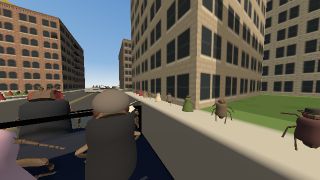
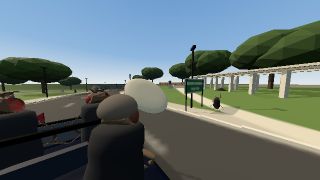
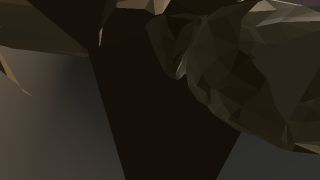
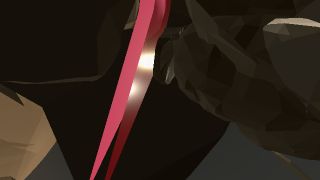
Frames rendered from the fly’s eye camera at four points in the timeline, each with the 32-column retinal input the connectome model receives at that moment.
Timeline
12 steps, with their times in the experiment
- 0:00Main Street
The motorcade runs west down Main Street between packed sidewalks. The open dark-blue limousine follows the lead car; four motorcycles flank its rear wheels and the follow-up car rides five feet behind, agents on its running boards.
- 0:12Right onto Houston
The cars turn right onto Houston Street and head north toward the seven-storey brick Book Depository. The crowd thins along the reflecting pools. In the sixth-floor south-east window a sash stands open.
- 0:24The sharp left onto Elm
The limousine slows almost to a walk for the hairpin left onto Elm Street, passing beneath the Depository and the roof sign’s clock. In the jump seat the governor’s wife turns to speak to the president.
- 0:33The first shot
Frame 133: the filmmaker on the concrete pedestal starts filming again. Near frame 160 a shot rings out and misses; a concrete chip flies from a curb near the triple underpass. Heads turn toward the Depository.
- 0:41Behind the freeway sign
The limousine passes behind the Stemmons Freeway sign. At about frame 223 one bullet passes through the president’s upper back and throat and the governor’s chest, wrist and thigh. The president emerges at frame 225 with both forelegs raised to his throat; the governor’s hat flips in his hand.
- 0:51Slowing
The car drifts and slows. The first lady leans in to look at the president, who slumps forward and to the left; the governor has collapsed into his wife’s lap.
- 0:55Frame 313
Frame by frame through the head shot. At frame 313 the right side of the president’s head bursts open in a red and pink cloud. Bone, brain and blood spray forward, up and back over the trunk and the motorcycle officers on the left; his head and body snap back and to the left onto the first lady.
- 1:11Onto the trunk
The first lady climbs out of her seat onto the back of the car and reaches across the trunk. The agent from the follow-up car’s left running board sprints, grabs the handhold and climbs onto the rear step, then pushes her back into the seat.
- 1:21Under the triple underpass
The limousine accelerates down Elm with the agent spread across the trunk and plunges into the shadow of the triple underpass, bound for the hospital. The film ends at frame 486.
- 1:30The grassy knoll
Spectators throw themselves onto the grass; a couple lies flat over the curb. A motorcycle officer drops his machine and runs up the knoll toward the picket fence while people stream up the slope behind him.
- 1:41The sixth floor
Inside the sixth-floor south-east corner: a wall of cartons shields the open window, two small boxes sit on the sill, three spent cartridge cases lie on the floor. The rifle was found later between boxes near the north-west stairs.
- 1:51Elm Street, 12:31
The plaza afterwards: the curb chip, the blood and skull fragments on the asphalt of Elm, the empty pedestal, the crowd at the fence. The Depository clock reads 12:31.
Setup
- Twelve seekable stages over 120 seconds: Main Street, the right turn onto Houston, the hairpin left onto Elm, the first shot near frame 160, behind the freeway sign near frames 223–225, slowing, frame 313 played frame by frame, onto the trunk, under the triple underpass (the film ends at frame 486), the grassy knoll, the sixth floor, and Elm Street at 12:31.
- Every motion is a function of the film frame (real time = frame / 18.3), so playback runs at about 1.4× real time on Main and Houston, real time on the turn, 0.4–0.5× through the first two shots and about 0.05× through frames 310–320; the gore uses the same physical time.
- On the metric plaza the car’s horizontal distances from the sixth-floor window match the 1964 survey table (CE 884) to within about 1 m at frames 161 and 313, the rifle line is about 18.6 m above the street, the filmmaker’s pedestal is 4 ft high, and the picket fence is about 5 ft high and 169 ft long.
- Flies stand about 1.3 m tall and are identified by role and clothing: the first lady in a pink suit and pillbox hat, the governor with his hat in hand and his wife, the driver and the front-seat agent, the follow-up car with agents on its running boards, the lead car, four motorcycle officers, the filmmaker and his receptionist on the pedestal, the man with the umbrella, the woman in the red raincoat and her friend with a Polaroid camera, a headscarf woman filming, the steamfitter on the wall, a couple on the grass and instanced spectators.
- Trajectory overlay (none by default; single bullet, shot from the fence, or both) draws display-only lines labelled THEORY, and Frame counter is on by default. Gore (Low / Standard / Extreme, default Extreme) and blood tone (cinematic red or fly hemolymph) are scene controls; the eye camera sees the splatter. A replay control returns to frame 313.
- Eight cameras: Director (auto), the filmmaker’s pedestal with a frame counter and playback rate, the sixth-floor window, behind the picket fence, the south side of Elm, inside the limousine, an aerial view of the plaza, and the fly’s eye.
Measurement
- Retinal-only input: the eye camera’s 32 luminance columns reach the fixed connectome model, measured spikes drive the neural display, and no direct stimulation is sent.
- The eye rides the president’s head: the crowd and the plaza until frame 313, then the floor of the car and the first lady, then the sky as he lies in her lap. The trajectory overlays, labels and frame counter are excluded from the eye image.
- The fly’s movements and the cast follow a pre-programmed timeline; measured spikes do not move the fly.
Limitations
- Approximated: the street grade (a single 7.3 m fall from Houston to the underpass), the hairpin, the knoll, the positions of the pergola, peristyles, fence corner, trees and freeway sign, the buildings other than the Depository, the crowd, car speeds outside the surveyed stretch and the order of the motorcycles.
- The size and shape of the spray at frame 313 and the splatter in the car are modeled at the chosen gore level; the muzzle flashes at the window are drawn for clarity.
- Disputed findings appear only as labelled overlays: the single-bullet trajectory of the 1964 presidential commission and a shot from behind the fence (House Select Committee acoustics, 1979, disputed by a National Academy of Sciences panel in 1982); a small smoke puff by the fence appears only with that overlay.
- Why the first lady climbed onto the trunk is not established. The couple on the grass is shown without their children, following the scene’s content exclusions.
Sources
No external sources are cited for this experiment.


