
The Wicker Man of Caesar's Gaul (Gallic War 6.16)
experimentNo. 0092categoryHistory & trainingrecordingpendingdataCC BY 4.0
The fly stands on the top deck of a woven wicker colossus's chest in an oak clearing at dusk, packed in with other flies and penned animals, as druids set the figure on fire. The scene follows Julius Caesar's Gallic War 6.16 and Strabo's Geography 4.4.5; both are outsiders' accounts, no archaeological trace of such a figure is known, and historians dispute how far they are propaganda.
An eight-second loop from the workstation. Full recording pending publication. Follow along for the release.
What the fly saw
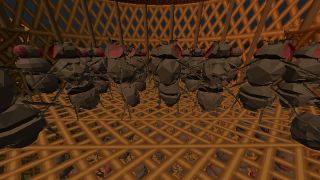
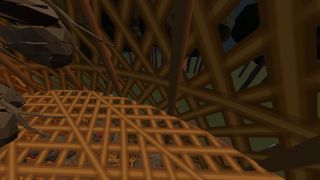
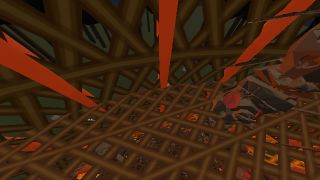
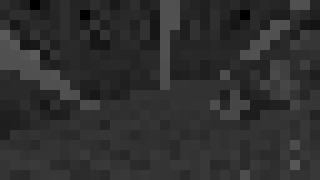
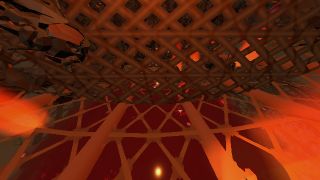
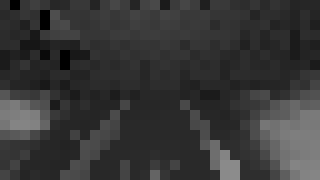
Frames rendered from the fly’s eye camera at four points in the timeline, each with the 32-column retinal input the connectome model receives at that moment.
Timeline
12 steps, with their times in the experiment
- 0:00Dusk in the clearing
An oak clearing at dusk. A woven colossus taller than the trees stands on its brush piles. The subject is inside its chest.
- 0:10Packing the figure
Flies climb a ladder at the back and crowd into the woven legs, body and head, deck above deck.
- 0:24Cattle and wild beasts
A cow is hoisted in a sling to the back door; a boar and a deer are already penned on the lowest deck (Strabo).
- 0:34Through the lattice
From inside the chest, the subject looks out through the woven osiers at the darkening clearing.
- 0:44Torch procession
White-robed druids file out of the trees with torches and circle the figure twice.
- 1:00Fire at the feet
The druids thrust their torches into the brush piles around both feet. Smoke rises and the first flames catch.
- 1:10The legs burn
Flames climb the woven legs. The osiers glow, blacken and thin; the flies in the legs scramble upward.
- 1:24Fire in the body
The fire reaches the decks of the body. The lattice around the subject lights up from below and smoke pours through the weave.
- 1:38Inferno
The whole colossus burns, arms and head ablaze, and sparks spiral into the night.
- 1:50Collapse
The burnt legs give way. The figure pitches forward and breaks open on the ground in a burst of sparks.
- 1:58The wreck burns
The broken body burns on the ground while the druids watch from the edge of the clearing.
- 2:10Ash
Night. A long heap of glowing ash and charred staves remains; the druids withdraw into the oaks.
Setup
- 12 seekable stages over 140 seconds: dusk in the clearing; packing the figure; cattle and wild beasts; through the lattice; torch procession; fire at the feet; the legs burn; fire in the body; inferno; collapse; the wreck burns; and ash.
- A woven figure taller than the oaks stands on brush piles, with two decks in the legs, three in the body and one in the head. Each woven band burns on its own programmed schedule as the fire climbs, its strips are eaten away, and the burnt legs give way so that the body pitches forward and breaks open on the ground.
- Cast: Flies inside sets 40–260 instanced flies (default 180) in the legs, body and head; those nearest the subject are low-detail anatomy and the rest are stand-ins of about 600 triangles. Six flies climb a ladder at the back, and nine white-robed druids with oak wreaths and torches circle the figure.
- Animals inside (Strabo; on by default) adds a cow hoisted in a sling to the back door, and a boar and a deer penned on the lowest deck. Warming input (VP2) is off by default. Gore (Low / Standard / Extreme, default Extreme) and blood tone (cinematic red or fly hemolymph) are scene controls, and the eye camera sees the splatter.
- 8 cameras: the clearing overview, low on the burning colossus, the chest with the subject behind the weave, a first-person fly view, the ladder and hoist at the back, the feet and brush piles, the torch procession, and the collapse from the side.
Measurement
- Assay backend: the eye camera's 32 luminance columns reach the fixed connectome model and measured spikes drive the neural display. The only optional extra is a bounded drive to the VP2 warming thermosensors (amplitude 0–1.2). It is off by default, it is a relative drive rather than a temperature, and every response reports it.
- When the drive is on, it follows the programmed fire at the subject's height, and after the collapse it follows the burning wreck.
- The eye sees the same lattice, flames and smoke as the viewport: the clearing through the weave, the lattice lit from below, the fire around the chest and the fall. Cue captions never reach it.
- The procession, burn front, popping and collapse follow a pre-programmed timeline; measured spikes do not move the fly.
Limitations
- Both accounts were written by outsiders: Caesar was at war with the Gauls, and Strabo drew on earlier Greek writers such as Posidonius. No archaeological trace of such a figure is known.
- The animals follow Strabo (Caesar mentions only men). The druids' white robes and the oak setting follow general classical descriptions of druids (Pliny), not a description of this rite.
- The figure's size, weave, decks, ladder, procession, burn front, popping, collapse and timing are approximations, and no combustion is simulated.
- The gore is cartoon splatter for an all-fly cast.


