
Galen's Vivisection and the Silenced Squeal (Laryngeal Nerves)
experimentNo. 0090categoryHistory & trainingrecordingpendingdataCC BY 4.0
The fly is tied on its back on Galen's board before an audience in a Roman hall, c. 163 AD; ligatures silence its buzz and releasing them restores it. This follows Galen's public demonstration in which tying a squealing pig's recurrent laryngeal nerves silenced it; a fly has no larynx and buzzes with its wings, so a stand-in thoracic nerve is tied and the wings stop.
An eight-second loop from the workstation. Full recording pending publication. Follow along for the release.
What the fly saw
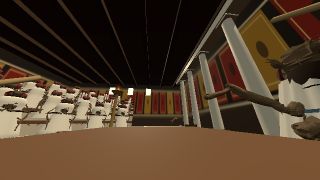
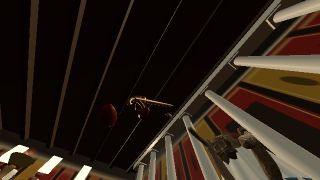
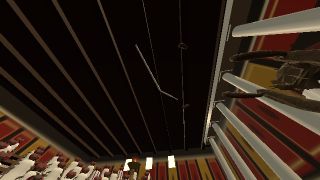
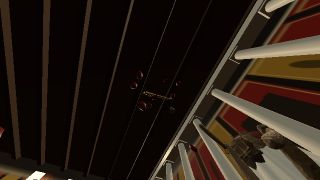
Frames rendered from the fly’s eye camera at four points in the timeline, each with the 32-column retinal input the connectome model receives at that moment.

Timeline
10 steps, with their times in the experiment
- 0:00The audience assembles
Physicians and philosophers in togas fill the curved benches of a Roman hall. Galen, in a Greek cloak, sets out scalpels, hooks and thread beside the board.
- 0:12Bound on the board
The fly is turned onto its back on a raised wooden rest and each of its six legs is tied to a peg with cord.
- 0:22The buzz
The fly buzzes: its wings beat in a blur against the air and the benches lean back from the noise.
- 0:32The incision
Galen draws a scalpel down the underside of the thorax, between the leg bases. Hemolymph wells up along the cut.
- 0:44Flaps pinned back
A hook pulls the cut cuticle aside and bronze pins hold the flaps open. Galen sponges the fluid that wells up.
- 0:56The nerve
With a blunt hook Galen lifts out a white nerve and holds it up so the back benches can see it.
- 1:06One ligature
He ties a thread around the left nerve. The left wing stops and the buzz drops to half.
- 1:18Silence
He ties the right nerve. The wings stop. The fly still strains at its cords, but there is no sound. The audience leans in.
- 1:30Release
Galen loosens both ligatures. The buzz comes back at full force and the beating wings spray the front row.
- 1:40Applause
The benches applaud. Galen bows and holds up the hook.
Setup
- 10 seekable stages over 110 seconds: the audience assembles; bound on the board; the buzz; the incision; flaps pinned back; the nerve; one ligature; silence; release; and applause.
- A Roman hall at metric scale (the standing fly is about 1.3 m), with painted red and ochre walls, a colonnade, an Asclepius figure in a niche, high windows, two oil lamps and six curved tiers of benches facing a low trestle board.
- Galen is an articulated cast fly in a Greek cloak, with a beard. Physicians and philosophers in togas fill the benches, some with a senator's purple stripes; Audience runs from 20 to 150 (default 90, instanced), and the middle of the front row are full-detail crowd figures.
- Galen cuts down the underside of the thorax, pins the flaps open, lifts a white nerve on a blunt hook and ties the left nerve and then the right, stopping first one wing and then both, before loosening both threads. Buzz lines (cartoon sound rings, on by default, display only) is a control, and a replay control jumps to the silence. Gore (Low / Standard / Extreme, default Extreme) and blood tone (cinematic red or fly hemolymph) are scene controls; the eye camera sees the splatter.
- 7 cameras: a director view, the hall from the top bench, the board at the ligatures, the wound from above, over Galen's shoulder to the benches, Galen from the front row, and the fly's eye.
Measurement
- Retinal-only input: the eye camera's 32 luminance columns reach the fixed connectome model, measured spikes drive the neural display, and no direct stimulation is sent.
- On its back, the fly's eye looks up at Galen's hands and instruments, the ceiling beams and the columns. The wing-beat blur and buzz rings are excluded from the eye image. So are the incision, flaps, pins, nerves and ligatures, which sit on the fly's own body (eye renders hide it), and cue captions never reach it.
- The buzz is wing motion of the shared fly, set by pre-programmed joint offsets. Galen, the audience and the fly follow a pre-programmed timeline; measured spikes do not move the fly.
Limitations
- Documented: Galen's public anatomical demonstrations in Rome in the 160s, and tying the recurrent laryngeal nerves of a squealing pig with threads, after which the animal went on struggling without a voice until they were released. The later books of On Anatomical Procedures, which include this demonstration, survive in Arabic.
- The wing substitution is an approximation. In a real fly the indirect flight muscles are supplied by thoracic nerves, and nothing here models them.
- The one-wing half-buzz step, which shows one nerve at a time, is not documented in Galen's text.
- The hall, audience, instruments, wound geometry and timing are approximations.


