
Brazen Bull of Phalaris (Sicilian Bull) at Akragas
experimentNo. 0088categoryHistory & trainingrecordingpendingdataCC BY 4.0
The fly is sealed inside the hollow bronze bull that ancient writers attribute to Phalaris, tyrant of Akragas (Agrigento, Sicily, c. 570–554 BC), and a fire is lit beneath it; a control puts the bronze-smith Perillus in first, as Diodorus Siculus tells it. The bull is legend: whether it existed is uncertain, and ancient writers already argued about it.
An eight-second loop from the workstation. Full recording pending publication. Follow along for the release.
What the fly saw
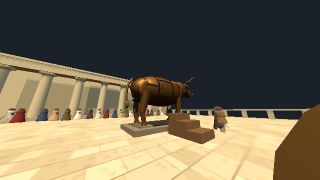
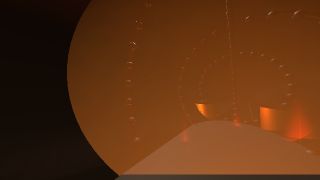
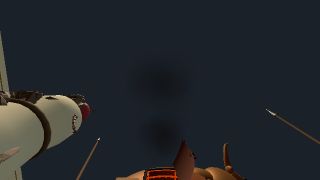
Frames rendered from the fly’s eye camera at four points in the timeline, each with the 32-column retinal input the connectome model receives at that moment.





Timeline
12 steps, with their times in the experiment
- 0:00The courtyard at Akragas
Noon in a colonnaded courtyard. Phalaris sits on his throne; a draped shape stands on a fire pit in the middle of the paving.
- 0:10Perillus unveils the bull
The craftsman pulls off the linen. A hollow bronze bull, larger than life, flashes in the sun.
- 0:20The hatch and the pipes
Perillus swings open the hatch in the bull’s flank and points to the two pipes set in its nostrils.
- 0:32Into the bull
The victim climbs the step and crawls in through the hatch. Perillus first: Phalaris points the inventor to his own door. The hatch is bolted.
- 0:44Firewood under the belly
Two servants stack split logs in the pit beneath the bull and a torch sets them alight.
- 0:54Inside the bronze
In the dark, the hatch outline shows a thread of daylight. Ring seams and rivets begin to warm.
- 1:04The bronze heats
Flames lick the belly. The bronze darkens, then glows dull red from below; the inside seams turn orange.
- 1:18The bull bellows
The trapped fly buzzes. Each burst jets steam rings and smoke from the nostril pipes. Phalaris claps.
- 1:32The bull glows
The fire roars. The bronze glows orange and the rings come in volleys while sparks spiral up past the horns.
- 1:44The fire is raked out
The servants drag the burning logs away. The bronze fades from orange back to a dull red.
- 1:54The hatch opens
The bolt is drawn and the hatch bangs open. Smoke pours out with a spray of cooked fly, and the victim tumbles onto the paving.
- 2:04Bones like jewels
A servant gathers the gleaming leg segments and threads them into a bracelet, which Phalaris holds up in the sun. Perillus first: the guards carry him to the parapet and throw him off the cliff.
Setup
- 12 seekable stages over 140 seconds: the courtyard at Akragas; Perillus unveils the bull; the hatch and the nostril pipes; into the bull; firewood under the belly; inside the bronze; the bronze heats; the bull bellows; the bull glows; the fire is raked out; the hatch opens; and a coda in which gleaming leg segments are threaded into a bracelet.
- A colonnaded courtyard on a cliff above the sea, with Phalaris on a gold-and-purple throne and a hollow bronze bull, larger than life, over a fire pit; it has a hinged hatch in its flank and two pipes in its nostrils. On a programmed heat curve the bronze darkens and glows from the belly up through black-body colours, from dull red to orange.
- Cast: Phalaris and Perillus as articulated cast flies, two guards, two servants who stack and light the firewood, and 22 instanced courtiers.
- Controls: Who goes in (the subject fly by default, or Perillus first, after Diodorus 9.19; the guards then pull him out half-cooked and throw him off the cliff while the subject watches from beside the throne), Steam rings from the nostrils (on by default) and Warming input (VP2, off by default). Gore (Low / Standard / Extreme, default Extreme) and blood tone (cinematic red or fly hemolymph) are also scene controls, and the eye camera sees the splatter.
- 8 cameras, including the courtyard overview, the bellowing head, under the belly, the parapet over the cliff, a first-person fly view and a cutaway of the fly inside, which hides the near half of the barrel in the viewport only.
Measurement
- Assay backend: the eye camera's 32 luminance columns reach the fixed connectome model and measured spikes drive the neural display. The only optional extra is a bounded drive to the VP2 warming thermosensors (amplitude 0–1.2). It is off by default, it is a relative drive rather than a temperature, and every response reports it.
- When the drive is on, its strength follows the bull's programmed heat while the subject is inside, is scaled down once it is ejected, and in Perillus-first mode is a small radiant-heat share of the fire.
- Inside, the eye image shows the dark interior, a thread of daylight round the hatch outline and then the glowing ring seams. The charred display double and the lens glints are excluded from it, and the cutaway changes only the viewport: the canonical eye keeps the closed shell.
- The fire, the fly's wing buzz, the steam rings and every figure follow a pre-programmed timeline; measured spikes do not move the fly.
Limitations
- Pindar (Pythian 1) links the bull with Phalaris within a century, and Diodorus Siculus (9.18–19) reports Perillus as its first victim; Polybius (12.25) argued against Timaeus about the bull. Historians treat it as legend, not established history.
- Bones that shone like jewels and were made into bracelets come from a modern retelling found in popular reference works, not from a passage traced to Lucian or another ancient author.
- The bull's shape, size, hatch position, seams, rivets, pipes and fire are approximations. The steam rings are a visual rendering of Lucian's pipes that turn cries into a bellow, not acoustics, and there is no audio.
- Charring, splatter and the flying leg segments are cartoon gore for an all-fly cast; flies have no bones.


