
README
T-Maze Odor Conditioning
experimentNo. 0068categoryLabs & sensesrecordingpendingdataCC BY 4.0
The fly undergoes a condensed Tully & Quinn odor-shock protocol: one odor paired with twelve shocks, a second odor unpaired, then a choice between two arms selected by a documented rule applied to measured readouts.
Recording pending publication. Follow along for the release.
Setup
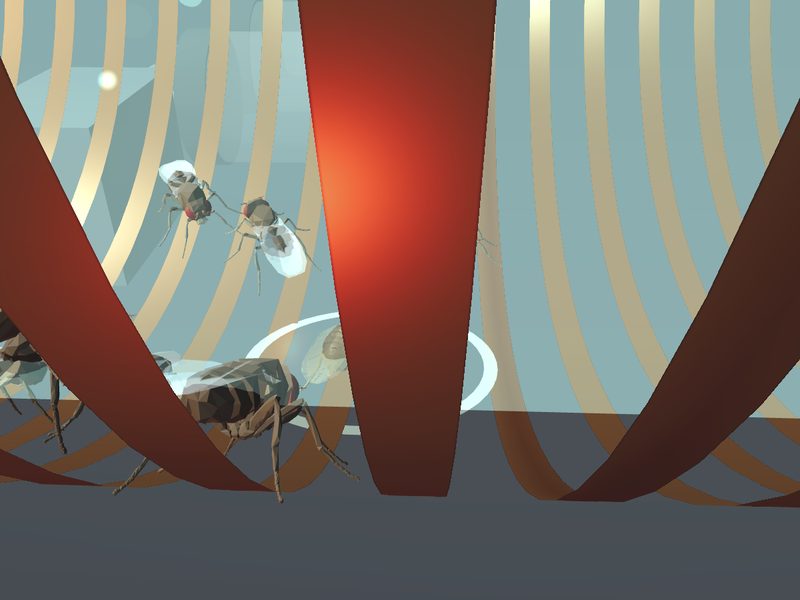
- Copper-grid training tube: 60 s CS+ odor with twelve 1.5 s, 60 V DC pulses (one every 5 s), 45 s fresh air, 60 s CS− odor, 45 s fresh air.
- Elevator transfer to the choice point, then a 2 min choice: the subject faces each arm in turn for 10 s, then enters an arm.
- Odors are 3-octanol (OCT) and 4-methylcyclohexanol (MCH); CS+ identity and the OCT arm side are selectable for reciprocal and side-balanced runs.
- A background cohort of about a hundred rendered flies is never counted.
- Cameras include apparatus overview, training tube / copper grid, choice point / both arms, subject eye view and the shock stimulator rig.
Measurement
- Retina is always on. Optional direct drives, all off by default: OCT → DM1 ORNs, MCH → DM2 ORNs, shock → PPL101 dopaminergic cells and/or tactile bristle afferents.
- Choice rule: mean measured MBON01–05 (or DNa02) readout per odor over settled sampling windows; the subject avoids the arm whose odor evoked the higher mean.
- PI = (avoid − approach) / (avoid + approach), from measured subject trials only; ties are excluded.
Limitations
- The engine has fixed weights and no plasticity, so the expected learned PI is zero; observed choices reflect fixed-weight odor responses and noise.
- Odors, shock and the choice are engineered proxies; DM1 and DM2 drives are not the receptor profiles of 3-octanol or 4-methylcyclohexanol.
- PPL101 stimulation is a transmitter label only: no dopamine chemistry or plasticity.