
Montauk Project Legend and Camp Hero Radar
experimentNo. 0066categoryHistory & trainingrecordingpendingdataCC BY 4.0
The fly watches the documented AN/FPS-35 radar at Montauk Air Force Station (Camp Hero, Long Island) turn at night, then follows a model of the 1992 Montauk Project legend underground to the "Montauk chair" and a time tunnel. Each stage is labeled as documented history or legend.
An eight-second loop from the workstation. Full recording pending publication. Follow along for the release.
What the fly saw
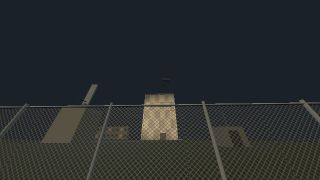
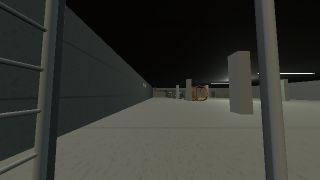
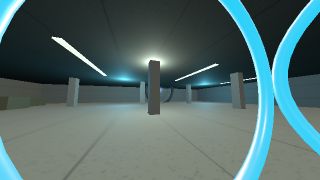
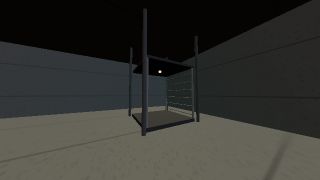
Frames rendered from the fly’s eye camera at four points in the timeline, each with the 32-column retinal input the connectome model receives at that moment.




Timeline
11 steps, with their times in the experiment
- 0:00Montauk Air Force Station / night
DOCUMENTED. The fly stops at the perimeter fence. Above the bluffs stands the five-storey concrete AN/FPS-35 tower with its 126-foot reflector.
- 0:16The AN/FPS-35 sweep
DOCUMENTED. The antenna turns once every 12 seconds (5 rpm), searching up to about 250 miles over the Atlantic for the SAGE air-defence network.
- 0:34Abandoned in place / 1981
DOCUMENTED. The station closed on 31 January 1981. The antenna stops; motors and electronics are removed.
- 0:44The legend begins
LEGEND. From here on the scene follows Nichols & Moon’s 1992 book. A hatch near the tower opens on a shaft.
- 0:52Legend: the underground levels
LEGEND. A cage descends past level after level beneath Camp Hero. The book claims many more; none has been found.
- 1:08Legend: the Montauk chair
LEGEND. The fly sits in a chair ringed by three pairs of coils; receivers record its “thought forms”.
- 1:28Legend: thought forms to the radar
LEGEND. Signals climb a waveguide to the transmitter; the dish above turns again in the dark.
- 1:42Legend: the time tunnel (1943 ↔ 1983)
LEGEND. A tunnel of light opens. The story ties it to the 1943 Philadelphia Experiment, forty years earlier.
- 2:04Legend: something comes through
LEGEND. A huge shadow gathers inside the tunnel. Equipment sparks; the fly backs away.
- 2:16Legend: the shutdown
LEGEND. A technician cuts the transmitter feed. The tunnel collapses and the levels fall into red emergency light.
- 2:30Camp Hero State Park / today
DOCUMENTED. Dawn over a state park. The tower still stands, listed on the National Register in 2002. No underground facility has been documented.
Setup
- Eleven seekable stages over 164 seconds: stages 1–3 and 11 show the documented station (the station at night, the radar sweep, the 31 January 1981 closure and Camp Hero State Park at dawn); stages 4–10 follow the legend.
- The AN/FPS-35 is modeled from published dimensions: a five-storey reinforced-concrete tower about 85 ft (25.9 m) tall and 60 ft (18.3 m) square, carrying a 126 × 38 ft (38.4 × 11.6 m) perforated reflector that turns once every 12 seconds (5 rpm) until the closure.
- Around it are an operations block, a height-finder tower, World War II camouflage (a gymnasium disguised as a church and bunkers with painted windows), the Battery 113 mound, the perimeter fence and the turning beam of the Montauk Point Light.
- The legend stages follow Preston Nichols and Peter Moon's book The Montauk Project: Experiments in Time (1992): a hatch and shaft, six underground levels each labeled "LEVEL n · LEGEND" (the book claims more), and the "Montauk chair", where the fly sits inside three orthogonal pairs of coils beside receivers and an oscilloscope.
- Signals climb a waveguide and the stopped antenna turns again; a time tunnel linked to 1943 and 1983 opens with a destroyer-escort silhouette from the related Philadelphia Experiment legend and a soft-edged shadow at its mouth, until an engineer fly cuts the feed and the levels fall into red emergency light.
- Seven cameras, including the perimeter fence, a close antenna orbit, an aerial view of the bluffs and lighthouse, an underground section, the chair and a time-tunnel cutaway; documented/legend title cards and an underground cutaway are viewport-only toggles.
Measurement
- Retinal-only live input: canonical eye images reach the fixed connectome model, measured spikes drive the neural display, and no direct stimulation is sent.
- The fly's route, the antenna rotation, the gate guard and two technician flies, and every legend event follow a pre-programmed timeline; the oscilloscope trace and coil glow are programmed animations, not a display of measured activity.
- Title cards and the underground cutaway apply only to viewport drawing, so the eye camera always receives the complete scene; a status line labels each stage DOCUMENTED or LEGEND.
Limitations
- The underground levels, chair, waveguide, time tunnel, shadow and shutdown model claims from a 1992 book; none is documented in the cited sources, and no underground facility at Camp Hero has been documented.
- Skeptoid's review cites Long Island's glacial till and water table as evidence against an underground base.
- Sources disagree on the reflector's rotating weight (about 40 versus about 70 tons), so no weight is shown.
- Terrain, building positions, the height finder and the lighthouse distance (compressed) are approximations, not a survey.
- Animated light intensities affect only the viewport; the canonical retina uses recorded intensities, while visibility changes reach both.


