
Maya Royal Bloodletting at Yaxchilan: Lintels 24 and 25
experimentNo. 0102categoryRituals & ceremoniesrecordingpendingdataCC BY 4.0
The fly is the queen of Yaxchilan in a reconstruction of Lintels 24 and 25 of Structure 23: kneeling under the king's flaming torch, it draws a barbed rope through its tongue onto bark paper in a basket (5 Eb 15 Mak, October 709), and from the burning paper a double-headed vision serpent rises with a warrior in its jaws.
An eight-second loop from the workstation. Full recording pending publication. Follow along for the release.
What the fly saw
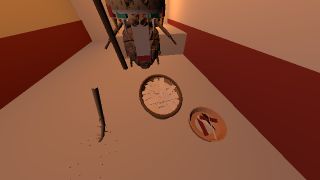
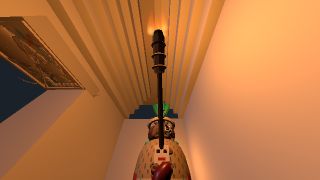
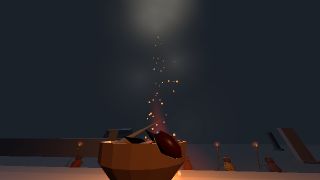
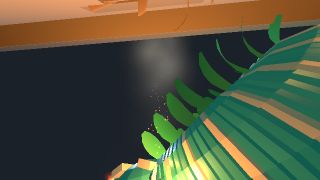
Frames rendered from the fly’s eye camera at four points in the timeline, each with the 32-column retinal input the connectome model receives at that moment.



Timeline
13 steps, with their times in the experiment
- 0:00Pa’chan on the Usumacinta
Night over Yaxchilan, called Pa’chan in its own inscriptions, in a horseshoe loop of the Usumacinta. Torchbearers light the queen across the Main Plaza toward Structure 23, which faces the river.
- 0:10Under Lintel 24
She climbs to the southeast doorway of Structure 23 and stops beneath its lintel. The carving is on the underside, so it is seen from below: the bloodletting of 5 Eb 15 Mak (October 709), cut in stone in the 720s.
- 0:22The queen’s regalia
Carved: a huipil woven in a diamond lattice with a fringed hem; a headdress with a mosaic Tlaloc mask sprouting quetzal plumes, with flower tassels on the band; a beaded collar with a sun-god pectoral; beaded wrist cuffs. She kneels before a woven basket of bark paper strips.
- 0:32The king’s torch
Carved: the king stands over her with a flaming torch (the text calls it a fiery spear), its burning head above her headdress. He wears quetzal plumes, a small head on his headband, a woven cape, a jade collar with a sun-god pectoral, a long strand of jade down his back and high-backed sandals.
- 0:40The tongue pierced
Not carved: the perforation itself. She extends her tongue, the fly’s proboscis, drives an obsidian lancet through it and feeds the end of the rope into the hole.
- 0:48The thorned rope
Carved: she draws a barbed rope through her tongue. Hand over hand the barbs go in clean and come out red. Blood runs down her chin and drips onto the paper in the basket; the drawn rope coils on top of it.
- 1:14Blood on the bark paper
The end of the rope comes through. She lets it fall onto the strips of bark paper, now soaked. Carved: scrolls of blood around her mouth.
- 1:24To the central doorway
Not carved: the move. She carries a bowl holding a stingray spine, the lancet and spattered paper to the central doorway and kneels outside it, facing the river. The king tips the soaked paper into a plate before her.
- 1:36The paper burns
The king touches his torch to the paper and steps away. The strips catch and smoke rises in front of the doorway. Lintel 25 shows the bowl of paper; burning it is the usual reading.
- 1:46The vision serpent
Carved on Lintel 25: a huge serpent with a head at each end rears out of the bowl of paper. Its body coils up through the smoke while the queen looks up, holding her bowl.
- 2:02A warrior in its jaws
Carved: from the front jaws a warrior in Teotihuacan regalia leans out with a spear and a shield; from the rear jaws comes a Tlaloc face. Readings of the warrior differ: the king himself, the dynasty’s founder, or the war god named in the text.
- 2:16Back into the smoke
The serpent sinks back into the smoke and the paper burns down to ash. The queen stays kneeling with her bowl. The lintel’s text, carved in mirror image, places her perforation facing the river.
- 2:26Carved in stone
Structure 23 was dedicated in 726 as the queen’s house. Lintels 24, 25 and 26 span its southeast, central and northwest doorways. Lintels 24 and 25 were cut out in 1882–83 and are now in the British Museum.
Setup
- 13 seekable stages over 158 seconds: Pa'chan on the Usumacinta, under Lintel 24, the queen's regalia, the king's torch, the tongue pierced, the thorned rope, blood on the bark paper, to the central doorway, the paper burns, the vision serpent, a warrior in its jaws, back into the smoke, and carved in stone.
- Night at Yaxchilan on a terrace inside a horseshoe loop of the Usumacinta, with Structure 33 on the hill behind, a ballcourt, ranges and stelae. Structure 23 has three doorways facing the river, a long room with a painted dado, end benches and a stepped corbel vault; the three lintels carry reliefs on their undersides, with 4–5 cm of relief and the glyph blocks as plain raised cartouches.
- Costumes follow the carvings in simplified shapes: the queen's fringed huipil, mosaic Tlaloc headdress with quetzal plumes and flower tassels, sun-god pectoral and beaded cuffs; the king's quetzal plumes, woven cape, jade collar with a sun-god pectoral and long strand of jade down the back. The king is an articulated fly, and six torchbearers light the plaza.
- The rope is drawn through hand over hand in twenty strokes during the 26-second rope stage, the blood running down the huipil and soaking the paper strips in the basket. The serpent carries jade disks and quetzal feathers along its back, with a warrior in a goggle-eyed Teotihuacan helmet, spear and round shield leaning from its front jaws and a goggle-eyed Tlaloc face at its rear head.
- Gore (Low / Standard / Extreme, default Extreme) and blood tone (cinematic red or fly hemolymph) are scene controls; the eye camera sees the splatter. Rope barbs: thorns (default) or obsidian blades. Serpent scale: towering over the plaza (default) or as in the carving. Lintel surface: paint traces in blue and red (default) or bare limestone.
- Eight cameras: director, the tongue and the rope, the Lintel 24 tableau through the southeast doorway, the serpent rising, the Lintel 25 tableau, the carved undersides, the river loop, and the eye in first person; a replay control jumps to the serpent.
Measurement
- Retinal-only input: the eye camera's 32 luminance columns reach the fixed connectome model, measured spikes drive the neural display, and no direct stimulation is sent.
- The eye image includes the plaza, the torchbearers and the façade, the underside of Lintel 24 from below, the basket, the king and his torch overhead through the whole perforation, the bowl and plate, the fire and smoke, and the serpent rising in front of her, the largest change in the retinal image. Her costume, tongue and the blood on her body are excluded as parts of her own body; the rope, basket, paper, drops, torch, king, serpent and warrior are scene content and reach the eye.
- The host's lights are switched off while the scene is loaded (restored exactly on unload). The fly's movements, the king and the serpent follow a pre-programmed timeline; measured spikes do not move the fly.
Limitations
- Not shown in the carvings: the setting inside Structure 23 (the rites predate its dedication in 726), the perforation and threading, the hand-over-hand pull, the rope's length and barb spacing, the move to the central doorway, the burning of the paper (the usual reading), the motion of the serpent and warrior, and the torchbearers. Stage texts mark which details are carved.
- The tongue is the fly's proboscis drawn out as a fleshy tongue so that the rope can be read; flies have no such tongue.
- Disputed: the barbs as thorns or obsidian (a control); the container as a woven basket or a ceramic cache vessel (shown as a basket); and the warrior as the king himself, the dynasty's founder or the war god named in the text, which the stage text leaves open. The Tlaloc face at the rear head comes from secondary descriptions and photographs.
- The site plan, river loop, Structure 23's room, vault and benches, Structure 33 and the relief figures (fly figures, not the carved humans) are approximations; the glyph blocks are blank cartouches, and the towering serpent is a cinematic enlargement.
- The king's own bloodletting, which some readings infer from his costume, is not shown.


