
The Great Death Pit of Ur: Royal Cemetery Sacrifice, c. 2550 BC
experimentNo. 0105categoryRituals & ceremoniesrecordingpendingdataCC BY 4.0
The fly watches the queen's burial in tomb PG 800 of the Royal Cemetery of Ur, then kneels in the Great Death Pit (PG 1237), 74 dead in the excavator's count, and is killed with a blow from a spiked copper axe, following CT findings of holes from a pointed weapon in two skulls; the stages label the excavator's poison reading and the CT findings side by side.
An eight-second loop from the workstation. Full recording pending publication. Follow along for the release.
What the fly saw
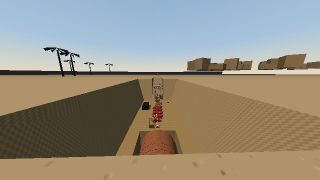
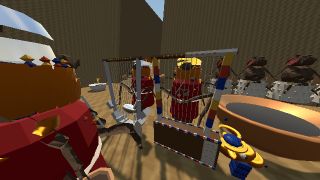
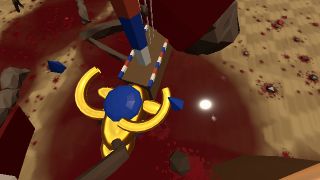
Frames rendered from the fly’s eye camera at four points in the timeline, each with the 32-column retinal input the connectome model receives at that moment.





Timeline
14 steps, with their times in the experiment
- 0:00The queen’s chamber
PG 800. In a stone chamber at the bottom of the shaft the queen lies on a wooden bier, a gold cup near her hand, a cloak of beads to her waist and a headdress of gold ribbon, ring pendants, beech and willow leaves and rosettes. Two attendants crouch at the head and foot of the bier while the vault is closed over them ring by ring.
- 0:12Into the queen’s pit
Five men with copper daggers lie down on the ramp. A sledge with gold lion heads is backed down, its team in front and the grooms at their heads. Ten women in gold, lapis and carnelian lie in two rows; at the end lies the harpist across her lyre with its gold bull’s head and lapis beard.
- 0:26The team, then the earth
A man comes down and strikes the two animals; they fall on top of their grooms. Earth is thrown in from above. A lapis cylinder seal is tossed into the filling over the chamber.
- 0:36Down the ramp of PG 1237
The Great Death Pit: a pit about 27 by 24 feet, its walls plastered and hung with matting. The court walks down the sloping approach three abreast: women in scarlet coats with gold and silver hair ribbons, the harpists carrying their lyres, the men-servants last.
- 0:50Taking places
The six men line up against the wall by the entrance. A great copper basin stands in front of them, the four harpists beside it, and the women kneel in four ordered rows facing them.
- 1:00The lyres
The harpists play: one lyre with a bearded bull’s head of heavy gold, one of silver with a cow’s head, a silver boat with a stag standing on it, and one of wood with two copper stags.
- 1:12The little cups
Each brought a small cup of clay, stone or metal. They raise them and drink. The excavator thought it was poison. Three men with spiked copper axes come down the ramp.
- 1:22The blows
What the CT scans showed instead: a hole about an inch across in the skull, cracks radiating from it. The axemen walk the rows and drive the spike into the back of each head, harpists first. The subject is struck from behind and pitches forward onto the floor.
- 1:40Heat and mercury
Pans of embers are carried along the rows and braziers burn at the walls; the bodies darken in the heat and smoke. Mercury is poured over them and red cinnabar dusted on: the study read this as a way to slow decay.
- 1:54Dressed and laid in rows
The bodies are lifted and laid on their sides in ordered rows, heads resting on the legs or feet of the row before. Ribbons and leaf bands are set straight; the lyres stand by the harpists, the men lie along the wall.
- 2:06The rows of gold
From above: rows of gold beech leaves and ribbons across the scarlet coats, the gold bull’s head among the lyres, the six men by the entrance and, in a corner, two goats of gold and lapis rearing against a flowering tree.
- 2:16Broken brick and earth
Workers at the rim tip baskets of broken brick over the dead, a few inches deep, then earth. The subject’s eye is buried.
- 2:281928–29: under the lamps
Forty-five centuries later. By lamplight the workmen clear the pit a square at a time, five or six bodies to a square. Gold beech leaves come up bright; the silver ribbons are gone to purple stains on the skulls. The excavator kneels over the subject.
- 2:42Wax and the silver ribbon
Boiling paraffin wax is poured over the subject’s head so it can be lifted whole with its ornaments. Beside it a woman’s silver ribbon, never worn, lies in a tight coil at her waist. Poison, as the excavator thought, or blows, heat and mercury, as the CT scans showed?
Setup
- 14 seekable stages over 174 seconds: the queen's chamber, into the queen's pit, the team, then the earth, down the ramp of PG 1237, taking places, the lyres, the little cups, the blows, heat and mercury, dressed and laid in rows, the rows of gold, broken brick and earth, 1928–29: under the lamps, and wax and the silver ribbon.
- PG 800: the queen on a wooden bier in a stone chamber whose brick vault is closed ring by ring, with a bead cloak, a gold cup and the great gold headdress; five men with copper daggers on the ramp, a sledge with gold lion heads backed down with its team and grooms, ten women in two rows and a harpist by a lyre with a gold bull's head. A lapis cylinder seal (banquet scene, shown without text) is tossed into the fill.
- PG 1237 holds 74 dead after the excavator's count: 64 women in scarlet coats with gold or silver hair ribbons and beech-leaf pendants, kneeling in four rows of sixteen; four harpists with their lyres (gold bearded bull, silver cow, silver boat with a stag, wood with two copper stags); six men-servants by the entrance; a great copper basin and a cup for each. Three axemen carry spiked copper axes.
- The pit floor is enlarged about 1.27× from the recorded 27 × 24 ft to 10.4 × 9.2 m so the fly bodies fit their rows; PG 1237 is about 6.5 m deep and PG 800 about 4.5 m. The 1928–29 coda shows the pit cleared square by square under lamps, the gold bright and the silver ribbons gone to purple stains, and paraffin wax poured over a head to lift it.
- Gore (Low / Standard / Extreme, default Extreme) and blood tone (cinematic red or fly hemolymph) are scene controls; the eye camera sees the splatter. Sledge team (PG 800): two asses (default, the excavator's record) or two oxen (as often retold). Captions (display only) are on by default.
- Nine cameras: director, the Great Death Pit, the rows of gold along the headdresses, the gold bull's-head lyre, down the ramp, the queen's chamber, the queen's pit with sledge and team, 1928 under the lamps, and the fly eye; a replay control jumps to the rows of gold.
Measurement
- Retinal-only input: the eye camera's 32 luminance columns reach the fixed connectome model, measured spikes drive the neural display, and no direct stimulation is sent.
- The eye image includes the queen's pit from the rim, the procession, the gold lyre, its own cup at its mouth, the axeman's approach, the fall to the floor, a view rolled with the body along the row of headdresses, falling brick, darkness when buried, the lamps and stars when its square is cleared, and milky white under the wax.
- Its own costume, wound, mercury and cinnabar and the captions are excluded from the eye; the shared fly's segments are never hidden or altered. The fly's movements and the cast follow a pre-programmed timeline; measured spikes do not move the fly.
Limitations
- The excavator read the cups as poison; CT scans of two skulls (one from PG 1237) found perimortem holes from a pointed weapon, heating and mercury compounds. Both readings are labelled, and whether the PG 1237 dead were killed in the pit is unknown.
- The three axemen, the order and timing, and the blow to the back of the head are pre-programmed, since published accounts give no wound positions; braziers, ember pans and a poured jar stand for the reported heating and mercury treatment, whose method is unknown.
- Counts differ between summaries (5 or 6 men, 64 or 68 women); whose death pit PG 800 is, and whether its team were asses or oxen, are questioned, so the team is a control.
- Pairing the two separate burials in one timeline, the subject watching from PG 800's rim, four rows of sixteen (the excavator's plan is not reproduced), leaf pendants on every woman, the coda's night lamps (the dig worked by day) and waxing the subject's own head are approximations. The date, c. 2550 BC (Early Dynastic IIIa), is approximate.
Sources
- Excavations at Ur: A Record of Twelve Years' Work (1954), public-domain text (Faded Page)
- Imaging Ur's Sacrificial Dead: An Archaeological CAT Scan (Expedition 49.2, Penn Museum, 2007)
- Human sacrifice and intentional corpse preservation in the Royal Cemetery of Ur (Antiquity 85, 2011)
- The History Blog: the CT findings on skulls from Ur
- Royal Cemetery at Ur, Wikipedia
- Lyres of Ur, Wikipedia


