
The Temple at Uppsala: The Ninth-Year Sacrifice in the Sacred Grove
experimentNo. 0106categoryRituals & ceremoniesrecordingpendingdataCC BY 4.0
The fly attends the nine-day feast at Gamla Uppsala as an 11th-century Bremen chronicler described it from informants: a temple adorned with gold and ringed by a golden chain, three gods, men, dogs and horses hanged in the grove, and a spring where it is thrust in alive and held under.
An eight-second loop from the workstation. Full recording pending publication. Follow along for the release.
What the fly saw
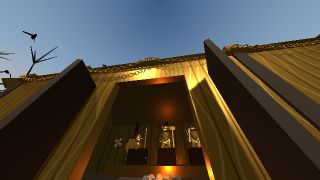
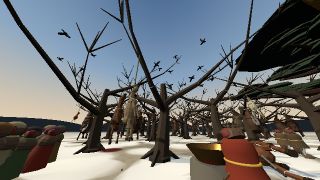
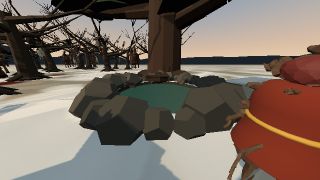
Frames rendered from the fly’s eye camera at four points in the timeline, each with the 32-column retinal input the connectome model receives at that moment.





Timeline
12 steps, with their times in the experiment
- 0:00Gamla Uppsala, the vernal equinox
Three great burial mounds stand on the ridge above the long hall terrace. People of every province come in across the fields; the hills close round the plain like a theatre.
- 0:10A temple adorned with gold
Beside the grove stands a timber temple entirely adorned with gold. A golden chain runs round the building and hangs from its gables; it catches the light from far off.
- 0:22Three gods
Inside, the people venerate three statues: the thunder god enthroned at the centre with his sceptre, the one-eyed god armed on one side, the fertility god on the other. Each god has priests who sacrifice for the people.
- 0:34Every ninth year
The common feast of all the provinces comes every ninth year and lasts nine days. Of every living thing that is male, nine are offered: each day a man and seven animals.
- 0:44Blood for the gods
A priest cuts a dog’s throat over a bronze basin and catches the blood for the gods. The carcass is hauled up into an oak by a rope round its neck.
- 0:56Stallions in the trees
A stallion’s throat is cut beside the oaks. Two priests haul it up by the neck over a high branch; its legs kick, then hang, and the blood runs down onto the snow.
- 1:08Men among the dogs and horses
A man is hoisted by a noose from the next tree. His legs kick and slow. Dogs and horses hang with him; the trees are held holy because of the dead hanging in them.
- 1:20The great evergreen tree
Near the temple stands a huge tree with far-spreading branches, green in winter and summer alike. Nobody knows what kind it is.
- 1:30The spring
At its foot is a spring where the sacrifices are made. The subject is led to the edge and thrust in alive, and a priest holds it under with a forked pole.
- 1:42If he is not found
The bubbles rise, slow and stop. If the man is not found again, the people’s wish will be granted. The body sinks out of reach.
- 1:52The grove at dusk
Seventy-two bodies hang together in the grove: men, stallions, dogs, rams, goats, boars, bulls and cocks, as a Christian informant said he had seen them. Crows work at the oldest.
- 2:12Secondhand
The chronicler never went to Uppsala; he wrote from what others told him. Excavation has found the three mounds, a great hall terrace and long rows of posts, but no golden temple.
Setup
- 12 seekable stages over 142 seconds: Gamla Uppsala at the vernal equinox, a temple adorned with gold, three gods, every ninth year, blood for the gods, stallions in the trees, men among the dogs and horses, the great evergreen tree, the spring, if he is not found, the grove at dusk, and secondhand.
- Gamla Uppsala with the three great mounds on the ridge, the hall terrace and its long hall, hills all round, patchy snow and about 110 people walking in. The timber temple is clad in gilded panels and shingles with crossed beast-head bargeboards, and a golden chain swags along the eaves and over both gables.
- Inside stand three gilded statues: the thunder god enthroned at the centre with a crown and a hammer-headed sceptre, the one-eyed god standing armed with helmet, spear and shield, and the fertility god enthroned with a sheaf.
- The grove holds 72 bodies: for each of nine days, one man and one each of seven male kinds of animal (stallion, dog, ram, goat, boar, bull, cock). The man hanged on the ninth day is an articulated fly; the fly is thrust face first into the spring beside the great evergreen and held under with a forked pole.
- Gore (Low / Standard / Extreme, default Extreme) and blood tone (cinematic red or fly hemolymph) are scene controls; the eye camera sees the splatter. Crows (circling, perching and pecking on pre-programmed paths) and late snow are on by default.
- Eight cameras: director, Gamla Uppsala with mounds and temple, the golden temple and its chain, the three gods inside, the grove at dusk, the spring under the evergreen, under the water looking up, and the fly eye; a replay control jumps to the grove at dusk.
Measurement
- Retinal-only input: the eye camera's 32 luminance columns reach the fixed connectome model, measured spikes drive the neural display, and no direct stimulation is sent.
- The rendered scene reaches the eye image; under water the eye sees the spring's volume, the surface and the branches above. The closing captions are excluded from the eye, and the fly's own body is never seen by its own eye.
- The fly's movements, the priests, the crowd and the crows follow a pre-programmed timeline; measured spikes do not move the fly.
Limitations
- The only account is secondhand: the chronicler never visited and wrote from informants for a missionary see, partly as polemic, and scholars separate possibly authentic tradition from literary convention. No golden temple has been found; the temple shown is a plausible timber hall, not a reconstruction from excavated evidence.
- The text names only men, dogs and horses among the hanged; the other kinds of animal, the killing methods (throat cut for animals, noose for men), the basin, the hauling, the forked pole and the subject's drowning are not documented in the cited sources. The number 72 appears twice in the text, as an informant's count and as the nine-day tally.
- Excavated at Gamla Uppsala: the three royal mounds (6th century), the hall terrace and its long hall (7th–9th century), postholes found under the church in 1926, whose reading as a temple is disputed after ground-penetrating radar surveys, and lines of large posts found in 2013, one about a kilometre long.
- Layout, sizes, the oak grove, the snow and all timing are approximations. One anatomical detail of the fertility god's statue in the text is omitted.


