
README
Astral Projection
experimentNo. 0016categoryAltered statesrecordingpendingdataCC BY 4.0
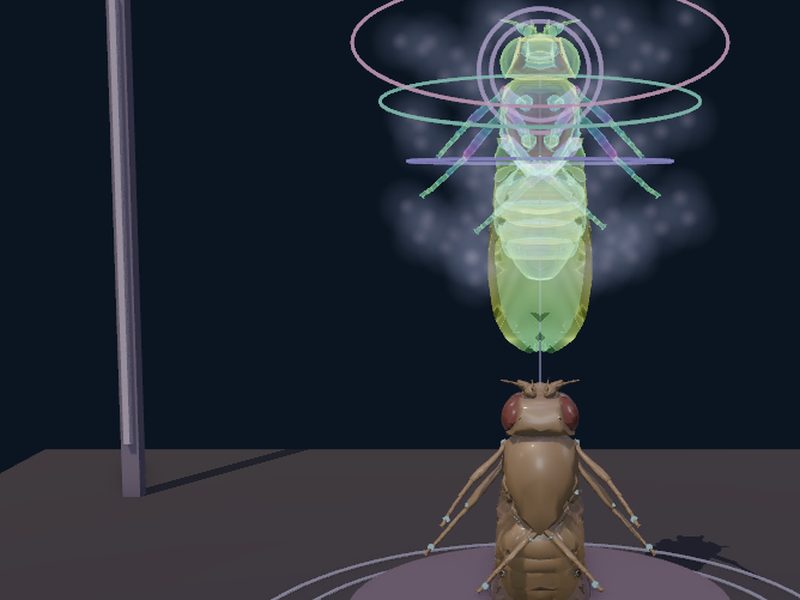
The fly sits upright and cross-legged on a meditation cushion while a programmed rainbow copy of its body floats above it. An external readout trained on retinal responses selects the copy's lateral alignment with a luminous focus.
Recording pending publication. Follow along for the release.
Setup
- An upright anatomical fly with crossed hind legs on a cushion; a copy of its articulated body floats above, with a moving rainbow shader, particle haze and orbiting rings.
- A luminous focus whose location varies between scene variations is part of the sensory scene.
- Controls: Train readout · 4 examples, Test frozen readout, and a demonstration control that plays the pre-programmed rising projection.
- Cameras: Projection, Front / crossed legs, Seated body, Astral double.
Measurement
- Retinal-only input: a fixed 32×18 image at each of four variations, reduced to 32 column luminance means and submitted for three 100 ms stimulus bins in paired connected and disconnected probes.
- An external nearest-example regressor reads six downstream population rates and chooses one lateral endpoint; frozen tests use separate noise seeds.
- Projection, haze and tether are display-only and excluded from acquisition; lift, pose and effects are pre-programmed.
Limitations
- The projection is a programmed visual effect, not evidence of an out-of-body phenomenon.
- Neural weights do not change; the task does not demonstrate biological learning.
- Only the lateral endpoint is decoded; other coordinates, timing and animation are pre-programmed.
Sources
No external sources are cited for this experiment.