
Ides of March, Rome 44 BC: Senate Hall Crime Scene Reconstruction
experimentNo. 0117categoryHistory & trainingrecordingpendingdataCC BY 4.0
The fly is the dictator, in a purple-bordered toga and laurel wreath, in an all-fly reconstruction of the killing in the Curia on 15 March 44 BC that follows four ancient accounts, from his arrival at the garden portico to three slaves carrying the body out on a litter.
An eight-second loop from the workstation. Full recording pending publication. Follow along for the release.
What the fly saw
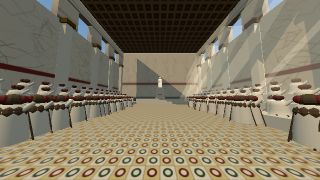
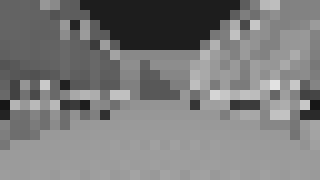
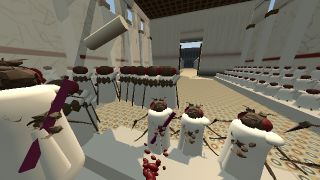
Frames rendered from the fly’s eye camera at four points in the timeline, each with the 32-column retinal input the connectome model receives at that moment.





Timeline
14 steps, with their times in the experiment
- 0:00The Portico of Pompey
Late morning in the garden portico behind the great stone theatre. The dictator steps down from his litter in a purple-bordered toga and laurel wreath. A man presses a scroll into his hand; he keeps it, unread.
- 0:10The consul kept outside
At the door of the hall one of the conspirators draws the consul aside and keeps him talking.
- 0:18Into the Curia
The senators rise from their benches as the dictator walks up the hall and sits in his gilded chair below the marble statue of the hall’s founder.
- 0:28A petition
A conspirator kneels to plead for his exiled brother. The others crowd round the chair as if to add their voices. The dictator waves him off.
- 0:38The toga pulled from the neck
The petitioner seizes the toga at both shoulders and drags it down from the neck: the signal.
- 0:43The first dagger
From behind the chair a dagger goes in just below the throat, a shallow wound. The dictator catches the arm and drives his writing stylus into it.
- 0:49The second, in the chest
He tries to rise. The second blow goes into his chest — the only one of all the wounds the physician later judged fatal.
- 0:55Daggers on every side
The conspirators close in, each wanting a blow. In the crush they wound one another; one takes a dagger through the hand.
- 1:07The toga over his face
Seeing daggers on every side, he pulls his toga over his head and with his left hand draws the lower edge down over his legs, to fall decently.
- 1:15At the foot of the statue
He goes down at the base of the founder’s statue, and its pedestal runs with his blood. Twenty-three wounds in all.
- 1:27The senators flee
The senators stampede for the doors. The conspirators file out with their bloody daggers raised, a cap of liberty carried on a spear.
- 1:37Alone for hours
The hall is empty. The body lies at the statue’s foot while the light from the high windows moves across the floor.
- 1:51The physician’s count
Of twenty-three wounds the physician judged only one fatal: the second, in the chest.
- 1:59Three slaves and a litter
Three slaves come in with a litter, uncover the face, lift the body and carry it home with one arm hanging down over the side.
Setup
- Fourteen seekable stages over 133 seconds: the portico, the consul kept outside, into the Curia, a petition, the toga pulled from the neck, the first dagger, the second in the chest, daggers on every side, the toga over his face, at the foot of the statue, the senators flee, alone for hours, the physician’s count, and three slaves with a litter.
- The hall, about 18 × 24 m, has a marble opus sectile floor, three tiers of benches on each side, clerestory windows, a coffered ceiling, and the gilded chair on a tribunal below the marble statue of the hall’s founder; outside lies the colonnaded garden portico with plane trees.
- Every person is a fly: 120 senators on the benches, ten articulated conspirators (among them the petitioner and the one cut through the hand) and 48 more, the consul and the conspirator who keeps him at the door, a man with a scroll, and the litter bearers.
- Following the ancient accounts: the scroll kept unread, the first blow just below the throat and the stylus driven into the attacker’s arm, the second blow, in the chest, that the physician judged the only fatal one, the toga drawn over the head and its hem pulled down with the left hand, the fall at the pedestal, the cap of liberty on a spear, and one foreleg hanging over the side of the litter.
- Gore (Low / Standard / Extreme, default Extreme) and blood tone (cinematic red or fly hemolymph) are scene controls; the eye camera sees the splatter. Wound count is 23 (the Roman biographers, default) or 35 (the Greek court historian), Light through the hours (on by default) moves sunlight across the floor while the body lies alone, and a replay control returns to the signal.
- Eight cameras: Director (auto), the hall from the door, the chair and the statue, the foot of the statue, from the high windows, the portico, the consul at the door, and the fly’s eye.
Measurement
- Retinal-only input: the eye camera’s 32 luminance columns reach the fixed connectome model, measured spikes drive the neural display, and no direct stimulation is sent.
- The toga, wreath, blood stains and wound markers on the fly are excluded from the eye image; the fold drawn over the head is not, so the eye goes dark inside the cloth until the slaves uncover the face.
- The fly’s movements and the cast follow a pre-programmed timeline; measured spikes do not move the fly.
Limitations
- The famous last words are reported as hearsay in the ancient sources and are not shown; who kept the consul at the door differs between accounts, and that figure is unnamed.
- The accounts give 23 or 35 wounds (a control); apart from the first two, the wound sites are approximations.
- The hall’s elevation, size, seating and decoration, the statue’s placement behind the chair, the chair tipping over, the scroll-giver and all timing are approximations; the hall’s remains lie behind temples B and C at Largo di Torre Argentina in Rome.
Sources
No external sources are cited for this experiment.


