
README
Chocolate River Boat Tunnel (1971)
experimentNo. 0052categoryRides & explorationrecordingpendingdataCC BY 4.0
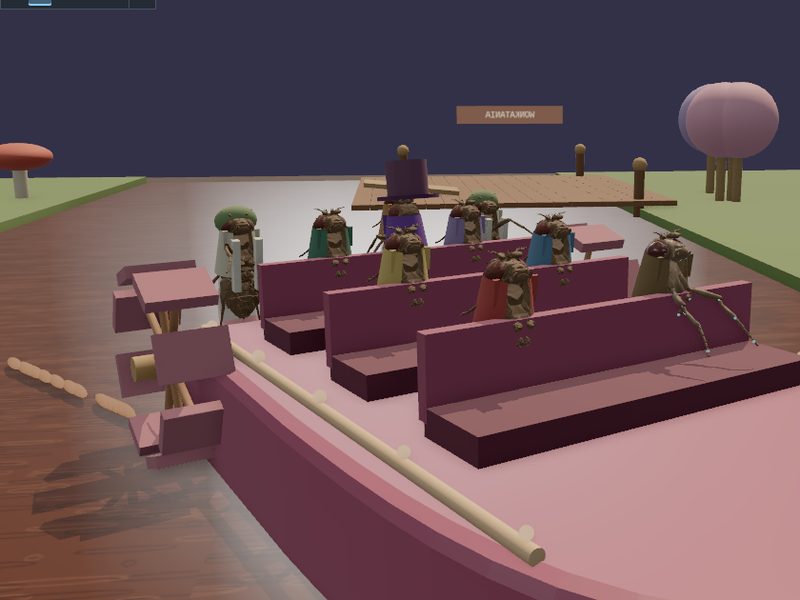
The fly boards a pink paddle boat in a confectionery garden, travels down a chocolate river and passes through a dark tunnel of projected eyes, crawling silhouettes and spirals before arriving at a calm landing.
Recording pending publication. Follow along for the release.
Setup
- Seven seekable stages over 168 seconds: garden embarkation, boarding, the river, the tunnel mouth, the dark passage, acceleration and arrival.
- All figures are flies: fly passengers, oarsmen and a host fly at the stern.
- Boat-relative passenger, front-passenger and stern cameras, plus loading-dock and route-cutaway views.
- Scene selector, previous/next, speed, loop and timeline controls; a replay control starts at the tunnel mouth.
Measurement
- Retinal-only live acquisition: canonical eye images reach the fixed connectome model and measured spikes drive the neural highlights.
- Boat motion, passenger posture and tunnel projections are pre-programmed; timeline controls do not train a neural policy.
- The route cutaway applies only to viewport drawing; the retina receives the complete scene.
Limitations
- A silent, original procedural model based on the 1971 film's boat sequence; no film footage, lyrics or soundtrack are reproduced.
- Geometry and timing are approximations, not frame-accurate replicas; tunnel projections are original canvas images.