
Tower of Babel and the Confusion of Tongues (Genesis 11)
experimentNo. 0082categoryRituals & ceremoniesrecordingpendingdataCC BY 4.0
The fly moulds mud bricks, dips them in bitumen and carries them up the stair of Etemenanki, the ziggurat of Babylon, until a column of light descends and every worker’s speech balloon switches to a different word for “brick”, following the text of Genesis 11:1–9.
An eight-second loop from the workstation. Full recording pending publication. Follow along for the release.
What the fly saw
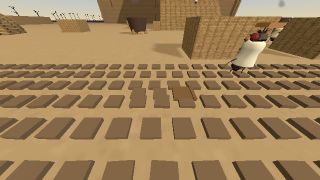
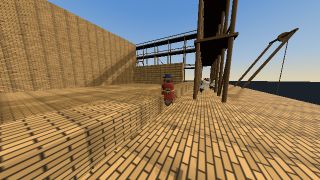
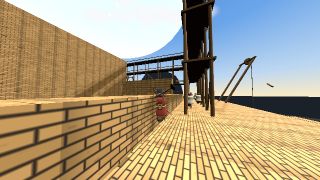
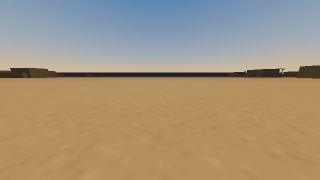
Frames rendered from the fly’s eye camera at four points in the timeline, each with the 32-column retinal input the connectome model receives at that moment.

Timeline
10 steps, with their times in the experiment
- 0:00A plain in the land of Shinar
Morning on the plain beside the river. The half-built tower rises over a brick yard; smoke drifts from the kilns.
- 0:10Let us make brick
The fly presses wet clay into a wooden mould and lifts it off. Rows of mud bricks dry in the sun; kilns glow as fired bricks come out.
- 0:24Slime had they for mortar
Black bitumen boils in pots over fires. Workers ladle it into baskets; the fly dips its brick.
- 0:34Up the great stair
Two lines of workers climb the stairway with bricks on their heads; an empty line comes back down. The fly joins the climb.
- 0:50Whose top may reach unto heaven
At the summit the fly sets its brick in bitumen on the rising temple wall. Hoists haul baskets; the plain lies far below.
- 1:04The LORD came down to see
Clouds open over the summit and a column of light descends onto the tower. Every worker stops and looks up.
- 1:14Confound their language
The balloons over the workers scramble between scripts. Orders go wrong: the fly hands over bitumen instead of a brick, a hoist lets go, bricks rain down and workers argue.
- 1:30The scaffolds fall
Scaffolds around the summit tip outward and crash onto the terrace below. Bricks tumble down the stairway in clouds of dust.
- 1:42Scattered abroad
Workers run down the stair and out across the plain in every direction, still shouting. The fly runs south.
- 1:58Therefore is the name of it called Babel
Evening. The unfinished tower stands over an empty yard of abandoned bricks and tools.
Setup
- 10 seekable stages over 128 seconds: a plain in the land of Shinar, let us make brick, slime had they for mortar, up the great stair, whose top may reach unto heaven, the LORD came down to see, confound their language, the scaffolds fall, scattered abroad, and therefore is the name of it called Babel.
- One scene unit equals one metre, with flies about 1.3 m tall. The default tower follows the Esagila tablet (Louvre AO 6555): six stages and a summit temple, about 91.5 m square at the base and about 91 m high, with stage heights of 33 m, 18.3 m and four of 6.1 m and a 15 m temple, built of a mud-brick core with a baked-brick mantle set in bitumen.
- The Tower control swaps in a spiral tower with arcades and treadwheel cranes after Pieter Bruegel the Elder’s 1563 painting, scaled to about 100 m. Workers sets 30–160 instanced fly workers (default 60) alongside an articulated foreman.
- As a ring of light spreads from the summit, each balloon changes from a shared brick pictogram to the word for “brick” in Greek (plinthos), Hebrew (levenim, as in 11:3), Latin (later), Chinese (zhuan), Arabic (tub), Hindi (int), Russian (kirpich), German (Ziegel) or Japanese (renga), or to cuneiform and hieroglyph signs, “?”, “!!” or grawlix. The fly hands the foreman a ladle of bitumen instead of a brick, hoists let go, bricks tumble down the stair and the summit scaffolds fall.
- Seven cameras: the land of Shinar, follow the fly, the great stair, the summit looking down, the fly eye in first person, the brick yard with kilns and bitumen, and an aerial view of the scattering. A replay control restarts at the confusion.
Measurement
- Retinal-only input: the eye camera’s 32 luminance columns reach the fixed connectome model, measured spikes drive the neural display, and no direct stimulation is sent.
- The speech balloons are viewport labels excluded from the retina, and the brick on the fly’s own head is excluded while it is carried. The sun, the evening and the light from above reach the eye; the viewport’s haze and its dimming of the host lights are display-only.
- The workers, the falling bricks and the fly’s day follow a pre-programmed timeline; measured spikes do not move the fly.
Limitations
- Identifying the biblical tower with Etemenanki is a common scholarly view, not a certainty, and Etemenanki’s surviving phase is Neo-Babylonian, far later than the story’s setting.
- The south stairway layout (a central flight to the second stage, two lateral flights along the first stage and steep upper flights), the buttress spacing, the unfinished summit, rope hoists, scaffolds, kilns and the city around the yard are approximations.
- The Bruegel option follows the form of a 1563 painting, not a building.
- The cuneiform and hieroglyph balloons are stylized signs, not readable text, and no dialogue is added.
- Workers gliding off the tower during the scattering are not in the text; no worker is hurt.


